Maths 2
Mines-PontsPC2026
Rédigé par IA, non vérifié
Signaler une erreur# Mines-Ponts PC — Maths 2 2026 · Corrigé brut
*Corrigé rédigé par IA (La Belle Copie), non officiel. Signalez toute erreur.*
**Solutions périodiques d'équations différentielles.** Durée 3 heures, calculatrice et tout dispositif électronique interdits. 25 questions.
Notations de l'énoncé : $(E)\ :\ y''+b(x)y=c(x)$ avec $b,c$ continues et $2\pi$-périodiques, $(EH)$ l'équation homogène, $\mathcal S(E)$, $\mathcal S(H)$ les ensembles de solutions (définies sur $\mathbb R$), $\mathcal B(E)$, $\mathcal B(H)$ les solutions bornées, $\|f\|=\sup_{\mathbb R}|f|$ sur $\mathbf B(\mathbb R,\mathbb R)$.
**Outil admis (théorème de Cauchy linéaire, au programme sans démonstration).** Si $b$ et $c$ sont continues sur $\mathbb R$, pour tout $(x_0,y_0,y_1)\in\mathbb R^3$ il existe une unique $f\in\mathcal C^2(\mathbb R,\mathbb R)$ solution de $(E)$ telle que $f(x_0)=y_0$ et $f'(x_0)=y_1$. Conséquence : $g\mapsto (g(0),g'(0))$ est un isomorphisme de $\mathcal S(H)$ sur $\mathbb R^2$ (linéaire, injectif par l'unicité, surjectif par l'existence), donc $\dim\mathcal S(H)=2$.
**Principe de superposition.** Si $f_1,f_2\in\mathcal S(E)$, alors $f_1-f_2\in\mathcal S(H)$ ; si $f\in\mathcal S(E)$ et $g\in\mathcal S(H)$, alors $f+g\in\mathcal S(E)$. En effet $y\mapsto y''+by$ est linéaire.
## Partie 1 — Résultats généraux
### Question 1
$\mathcal B(H)=\mathcal S(H)\cap\mathbf B(\mathbb R,\mathbb R)\subset\mathcal S(H)$. La fonction nulle est une solution bornée de $(EH)$. Si $g_1,g_2\in\mathcal B(H)$ et $\lambda\in\mathbb R$, alors $\lambda g_1+g_2\in\mathcal S(H)$ ($\mathcal S(H)$ est un espace vectoriel) et, pour tout $x$, $|\lambda g_1(x)+g_2(x)|\le|\lambda|\,\|g_1\|+\|g_2\|$ : elle est bornée.
**$\mathcal B(H)$ est un sous-espace vectoriel de $\mathcal S(H)$.**
### Question 2
Soit $f_0\in\mathcal B(E)$.
- Si $f\in\mathcal B(E)$, $g=f-f_0\in\mathcal S(H)$ par superposition, et $\|g\|\le\|f\|+\|f_0\|$ : $g\in\mathcal B(H)$ et $f=f_0+g$.
- Si $g\in\mathcal B(H)$, $f_0+g\in\mathcal S(E)$ par superposition, et il est borné comme somme de fonctions bornées : $f_0+g\in\mathcal B(E)$.
$$\boxed{\mathcal B(E)=\{f_0+g,\ g\in\mathcal B(H)\}.}$$
### Question 3
Soit $f\in\mathcal S(E)$. $T(f)$ est la composée de $f$ et de $x\mapsto x+2\pi$, donc de classe $\mathcal C^2$, avec $T(f)''(x)=f''(x+2\pi)$. Pour tout $x$, par $2\pi$-périodicité de $b$ puis de $c$ :
$$T(f)''(x)+b(x)T(f)(x)=f''(x+2\pi)+b(x+2\pi)f(x+2\pi)=c(x+2\pi)=c(x).$$
**$T(f)$ est solution de $(E)$.** Le même calcul avec $c=0$ montre que $T$ envoie $\mathcal S(H)$ dans $\mathcal S(H)$ ; de plus $\|T(f)\|=\|f\|$ pour $f$ bornée (le sup sur $\mathbb R$ est invariant par translation).
### Question 4
Soit $h=T(f)-f$. Par la question 3 et la superposition, $h\in\mathcal S(H)$. De plus $h(0)=f(2\pi)-f(0)=0$ et $h'(0)=f'(2\pi)-f'(0)=0$. La fonction nulle est solution de $(EH)$ avec les mêmes conditions initiales en $0$ ; par unicité dans le théorème de Cauchy linéaire, $h=0$, c'est-à-dire $f(x+2\pi)=f(x)$ pour tout $x\in\mathbb R$.
**$f$ est $2\pi$-périodique.**
## Partie 2 — Un exemple d'équation à coefficients constants
Ici $\omega>0$, $\omega\neq1$, et $(E)\ :\ y''+\omega^2y=\cos x$.
### Question 5
Pour $f_0=d\cos$, $f_0''+\omega^2f_0=d(\omega^2-1)\cos$. Comme $\omega^2\neq1$ :
$$\boxed{d=\frac{1}{\omega^2-1}.}$$
L'équation caractéristique $r^2+\omega^2=0$ a pour racines $\pm i\omega$ ; les solutions réelles de $(EH)$ sont les $x\mapsto\alpha\cos(\omega x)+\beta\sin(\omega x)$, de valeur $\alpha$ et de dérivée $\beta\omega$ en $0$. D'où
$$\boxed{u(x)=\cos(\omega x),\qquad v(x)=\frac{\sin(\omega x)}{\omega}.}$$
### Question 6
$\mathcal S(H)=\operatorname{Vect}(u,v)$ et $\mathcal S(E)=f_0+\mathcal S(H)$ :
$$\boxed{\mathcal S(E)=\Big\{x\mapsto\frac{\cos x}{\omega^2-1}+A\cos(\omega x)+\frac{B}{\omega}\sin(\omega x),\ (A,B)\in\mathbb R^2\Big\}.}$$
Toute solution est bornée, par $\frac{1}{|\omega^2-1|}+|A|+\frac{|B|}{\omega}$. Donc
$$\boxed{\mathcal B(E)=\mathcal S(E).}$$
### Question 7
Soit $T>0$ une période de $f$. En dérivant deux fois $f(x+T)=f(x)$, on obtient $f''(x+T)=f''(x)$, donc pour tout $x$ :
$$\cos(x+T)=f''(x+T)+\omega^2f(x+T)=f''(x)+\omega^2f(x)=\cos x.$$
En $x=0$ : $\cos T=1$, donc $T\in2\pi\mathbb Z$ ; comme $T>0$ :
$$\boxed{T=2k\pi,\quad k\in\mathbb N^*.}$$
### Question 8
Posons $\theta=2k\pi\omega$. On a $f(x)=d\cos x+A\cos(\omega x)+\frac B\omega\sin(\omega x)$ et $f'(x)=-d\sin x-A\omega\sin(\omega x)+B\cos(\omega x)$. Comme $\cos(2k\pi)=1$ et $\sin(2k\pi)=0$ :
$$f(0)=d+A,\quad f(2k\pi)=d+A\cos\theta+\frac B\omega\sin\theta,\quad f'(0)=B,\quad f'(2k\pi)=-A\omega\sin\theta+B\cos\theta.$$
La $2k\pi$-périodicité de $f$ (et donc de $f'$) donne $f(2k\pi)=f(0)$ et $f'(2k\pi)=f'(0)$, soit
$$\boxed{\begin{cases}(\cos(2k\pi\omega)-1)A+\dfrac{\sin(2k\pi\omega)}{\omega}B=0\\[2mm]-\omega\sin(2k\pi\omega)A+(\cos(2k\pi\omega)-1)B=0.\end{cases}}$$
### Question 9
$$\det M=(\cos\theta-1)^2+\sin^2\theta=2(1-\cos\theta)=4\sin^2(k\pi\omega).$$
Il est nul si et seulement si $\theta\in2\pi\mathbb Z$, c'est-à-dire $k\omega\in\mathbb Z$. Si $\omega\notin\mathbb Q$, alors $k\omega\notin\mathbb Z$ (sinon $\omega=m/k$ avec $k\in\mathbb N^*$), donc $\det M\neq0$, le système homogène de la question 8 n'a que la solution $A=B=0$, et $f=f_0$. Réciproquement $f_0=d\cos$ est une solution $2\pi$-périodique.
**Si $\omega\notin\mathbb Q$, la seule solution périodique de $(E)$ est $f_0$.**
### Question 10
Soit $\omega=p/q$, $p,q\in\mathbb N^*$, et $f\in\mathcal S(E)$ quelconque (question 6). On a $\cos(x+2q\pi)=\cos x$ et $\omega(x+2q\pi)=\omega x+2p\pi$, donc $\cos(\omega(x+2q\pi))=\cos(\omega x)$ et $\sin(\omega(x+2q\pi))=\sin(\omega x)$. Ainsi $f(x+2q\pi)=f(x)$ pour tout $x$.
$$\boxed{2q\pi\ \text{est une période commune à toutes les solutions.}}$$
## Partie 3 — Unicité lorsque la fonction $b$ est négative
Ici $b(x)=-(1+\cos x)$, et $(EH)\ :\ y''=(1+\cos x)y$.
### Question 11
*Critère utilisé.* Si $\varphi\in\mathcal C^2(\mathbb R,\mathbb R)$ et $\varphi''\ge0$, alors $\varphi$ est convexe. En effet $\varphi'$ est croissante ; pour $x<y$, $\lambda\in\,]0,1[$ et $z=\lambda x+(1-\lambda)y$, l'égalité des accroissements finis donne $c_1\in\,]x,z[$, $c_2\in\,]z,y[$ avec
$$\lambda\varphi(x)+(1-\lambda)\varphi(y)-\varphi(z)=\lambda(1-\lambda)(y-x)\big(\varphi'(c_2)-\varphi'(c_1)\big)\ge0,$$
car $z-x=(1-\lambda)(y-x)$, $y-z=\lambda(y-x)$ et $c_1<c_2$.
*Application.* Soit $g\in\mathcal S(H)$ et $\varphi=g^2\in\mathcal C^2$. Alors $\varphi'=2gg'$ et
$$\varphi''=2g'^2+2gg''=2g'^2+2(1+\cos x)g^2\ge0,$$
puisque $1+\cos x\ge0$ pour tout $x$. **$g^2$ est convexe.**
### Question 12
Soit $g\in\mathcal B(H)$. Alors $\varphi=g^2$ est convexe et majorée par $\|g\|^2$ ; par le résultat admis, $\varphi$ est constante. Donc $\varphi''=0$ :
$$\forall x\in\mathbb R,\quad 2g'(x)^2+2(1+\cos x)g(x)^2=0.$$
Les deux termes sont positifs, donc nuls ; en $x=0$, $2g(0)^2=0$. Ainsi $g^2$ est la constante $g(0)^2=0$, et $g=0$.
$$\boxed{\mathcal B(H)=\{0\}.}$$
### Question 13
Si $f_1,f_2\in\mathcal B(E)$, alors $f_1-f_2\in\mathcal S(H)$ (superposition) et est bornée, donc $f_1-f_2\in\mathcal B(H)=\{0\}$.
**$(E)$ possède au plus une solution bornée.**
### Question 14
Soit $f\in\mathcal B(E)$. Par la question 3, $T(f)\in\mathcal S(E)$, et $\|T(f)\|=\|f\|<+\infty$, donc $T(f)\in\mathcal B(E)$. Par la question 13, $T(f)=f$ : $f(x+2\pi)=f(x)$ pour tout $x$.
**La solution bornée est elle-même $2\pi$-périodique ; $(E)$ possède donc une solution $2\pi$-périodique.**
## Partie 4 — Existence d'une solution périodique
$b(x)=-(1+\cos x)$ ; $(a_n)_{n\ge1}$ est bornée par $M$ et vérifie $(n^2+1)a_n+\frac12(a_{n+1}+a_{n-1})=0$ pour $n\ge2$, et $4a_1+a_2=-2$.
### Question 15
Pour $n\ge2$, les indices $n\pm1$ sont dans $\mathbb N^*$, donc
$$|a_n|\le\frac{|a_{n+1}|+|a_{n-1}|}{2(n^2+1)}\le\frac{M}{n^2+1}\le\frac{M}{n^2}\qquad(\ast)$$
Par comparaison à la série de Riemann $\sum1/n^2$, **$\sum a_n$ converge absolument**.
Pour $n\ge3$, on a $n-1\ge2$ et $n+1\ge2$, donc $(\ast)$ s'applique aux rangs $n\pm1$ : $|a_{n\pm1}|\le\frac{M}{(n-1)^2}$. En reportant dans la relation :
$$|a_n|\le\frac{1}{2(n^2+1)}\cdot\frac{2M}{(n-1)^2}\le\frac{M}{n^2(n-1)^2},\qquad\text{donc}\qquad n^2|a_n|\le\frac{M}{(n-1)^2}\quad(n\ge3).$$
Par comparaison, **$\sum n^2a_n$ converge absolument.**
### Question 16
Soit $u_n(x)=a_n\sin(nx)$, de classe $\mathcal C^2$, avec $u_n'(x)=na_n\cos(nx)$, $u_n''(x)=-n^2a_n\sin(nx)$. Pour tout $x$ :
$$|u_n(x)|\le|a_n|,\qquad|u_n'(x)|\le n^2|a_n|,\qquad|u_n''(x)|\le n^2|a_n|.$$
Par la question 15, $\sum u_n$, $\sum u_n'$, $\sum u_n''$ convergent normalement donc uniformément sur $\mathbb R$. Par le théorème de dérivation terme à terme (extension à la classe $\mathcal C^2$), $g$ est de classe $\mathcal C^2$ et $g''(x)=-\sum_{n\ge1}n^2a_n\sin(nx)$.
Avec $\cos x\sin(nx)=\frac12\big(\sin((n+1)x)+\sin((n-1)x)\big)$ et des séries absolument convergentes (termes majorés par $|a_n|$), on peut séparer et réindexer :
$$\cos x\,g(x)=\frac12\sum_{n\ge2}a_{n-1}\sin(nx)+\frac12\sum_{n\ge1}a_{n+1}\sin(nx),$$
le terme $n=1$ de $\sum a_n\sin((n-1)x)$ étant nul. Donc
$$g''(x)-(1+\cos x)g(x)=-\Big(2a_1+\frac{a_2}{2}\Big)\sin x-\sum_{n\ge2}\Big[(n^2+1)a_n+\frac12(a_{n+1}+a_{n-1})\Big]\sin(nx).$$
Chaque crochet est nul, et $2a_1+\frac{a_2}2=\frac12(4a_1+a_2)=-1$. Ainsi
$$\boxed{\forall x\in\mathbb R,\quad g''(x)-(1+\cos x)g(x)=\sin x.}$$
### Question 17
Pour $n,m\in\mathbb N^*$, $\sin(nt)\sin(mt)=\frac12\big(\cos((n-m)t)-\cos((n+m)t)\big)$ et $\int_0^{2\pi}\cos(pt)\,\mathrm dt=0$ pour $p\in\mathbb Z^*$. Comme $n+m\neq0$ :
$$\int_0^{2\pi}s_n(t)s_m(t)\,\mathrm dt=\begin{cases}0&\text{si }n\neq m,\\ \pi&\text{si }n=m.\end{cases}$$
Si $\sum_{k=1}^N\beta_ks_k=0$, on multiplie par $s_m$ ($1\le m\le N$) et on intègre sur $[0,2\pi]$ (somme finie) : $\pi\beta_m=0$. La famille est libre ; elle engendre $\mathcal P_N$ par définition.
**$(s_1,\dots,s_N)$ est une base de $\mathcal P_N$, et $\dim\mathcal P_N=N$.**
### Question 18
$s_n''=-n^2s_n$ et $\cos x\sin(nx)=\frac12\big(s_{n+1}(x)+s_{n-1}(x)\big)$, y compris pour $n=1$ avec $s_0=0$. Donc
$$\boxed{L(s_n)=-(n^2+1)s_n-\frac12s_{n+1}-\frac12s_{n-1}\qquad(n\ge1,\ s_0=0).}$$
En particulier $L(s_1)=-2s_1-\frac12s_2$.
### Question 19
*Endomorphisme.* $L$ est linéaire et $L(s_n)\in\mathcal P_{n+1}\subset\mathcal P$ pour tout $n$ ; comme $\mathcal P=\operatorname{Vect}(s_n)_{n\ge1}$, $L(\mathcal P)\subset\mathcal P$.
*Observation clé.* Soit $p\in\mathcal P\setminus\{0\}$ ; par la question 17 il s'écrit de façon unique $p=\sum_{k=1}^N\beta_ks_k$ avec $\beta_N\neq0$. Par la question 18, $L(p)\in\mathcal P_{N+1}$ et sa coordonnée sur $s_{N+1}$ (dans la base de $\mathcal P_{N+1}$) ne provient que du terme $k=N$ : elle vaut $-\frac12\beta_N\neq0$.
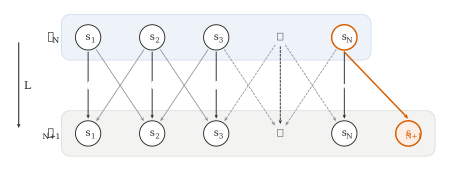
*Injectivité.* Si $p\neq0$, $L(p)$ a une coordonnée non nulle, donc $L(p)\neq0$ : $\ker L=\{0\}$.
*$s_1\notin\operatorname{Im}L$.* Si $s_1=L(p)$, alors $p\neq0$ (car $s_1\neq0$) ; avec $N$ comme ci-dessus, la coordonnée de $L(p)$ sur $s_{N+1}$, $N+1\ge2$, est non nulle, alors que celle de $s_1$ est nulle : contradiction par unicité des coordonnées.
**$L$ est un endomorphisme injectif de $\mathcal P$ et $s_1\notin\operatorname{Im}L$.**
### Question 20
Soit $N\ge1$. Par la question 18, $L(s_k)\in\mathcal P_{k+1}\subset\mathcal P_{N+1}$ pour $k\le N$, donc $L(\mathcal P_N)\subset\mathcal P_{N+1}$ ; et $\mathcal P_1\subset\mathcal P_{N+1}$.
Si $y\in L(\mathcal P_N)\cap\mathcal P_1$, $y=L(p)=\lambda s_1$ ; si $\lambda\neq0$, $s_1=L(p/\lambda)\in\operatorname{Im}L$, ce qui contredit la question 19. Donc $\lambda=0$, $y=0$ : la somme est directe.
$L$ est injective, donc $\dim L(\mathcal P_N)=\dim\mathcal P_N=N$, et $\dim\big(L(\mathcal P_N)\oplus\mathcal P_1\big)=N+1=\dim\mathcal P_{N+1}$. Un sous-espace de même dimension finie que l'espace qui le contient lui est égal :
$$\boxed{L(\mathcal P_N)\oplus\mathcal P_1=\mathcal P_{N+1}.}$$
### Question 21
Soit $c\in\mathcal P$ : il existe $N$ avec $c\in\mathcal P_N\subset\mathcal P_{N+1}$. Par la question 20, $c=L(p)+\lambda s_1$ avec $p\in\mathcal P_N$, $\lambda\in\mathbb R$. Posons $f=p+\lambda g$ ($g$ de la question 16). Alors $f\in\mathcal C^2$ et
$$f''-(1+\cos x)f=L(p)+\lambda\big(g''-(1+\cos x)g\big)=L(p)+\lambda s_1=c,$$
donc $f\in\mathcal S(E)$. $p$ est $2\pi$-périodique (combinaison finie de $s_k$) ; $g$ aussi : les sommes partielles $\sum_{n\le K}a_n\sin(nx)$ sont $2\pi$-périodiques et l'égalité $\sum_{n\le K}a_n\sin(n(x+2\pi))=\sum_{n\le K}a_n\sin(nx)$ passe à la limite $K\to+\infty$.
**$f=p+\lambda g$ est une solution $2\pi$-périodique de $(E)$.**
## Partie 5 — Un théorème général
$b,c$ continues $2\pi$-périodiques, $c\neq0$ ; $f_0\in\mathcal S(E)$ avec $f_0$ et $f_0'$ bornées, $M_0=\|f_0\|$, $M_1=\|f_0'\|$, $\mathcal A=\{f\in\mathcal B(E),\ \|f\|\le M_0\}$.
### Question 22
On pose
$$\boxed{\mathcal H=\operatorname{Vect}(f_0)+\mathcal B(H).}$$
$f_0$ est bornée et $\mathcal B(H)\subset\mathbf B(\mathbb R,\mathbb R)$ est un sous-espace vectoriel (question 1), donc $\mathcal H$ est un sous-espace vectoriel de $\mathbf B(\mathbb R,\mathbb R)$, de dimension au plus $1+\dim\mathcal S(H)=3$. Comme $f_0\in\mathcal B(E)$, la question 2 donne $\mathcal A\subset\mathcal B(E)=f_0+\mathcal B(H)\subset\mathcal H$. Tous les éléments de $\mathcal H$ sont de classe $\mathcal C^2$.
- *Non vide* : $f_0\in\mathcal B(E)$ et $\|f_0\|=M_0$, donc $f_0\in\mathcal A$.
- *Bornée* : $\mathcal A$ est contenue dans la boule fermée de centre $0$ et de rayon $M_0$.
- *Fermée* (caractérisation séquentielle) : soit $(f_n)$ une suite de $\mathcal A$ convergeant dans $(\mathcal H,\|\cdot\|)$ vers $f\in\mathcal H$. Pour $x\in\mathbb R$ fixé, $\ell_x:h\mapsto h''(x)+b(x)h(x)$ est une forme linéaire sur $\mathcal H$, continue car $\mathcal H$ est de dimension finie. Donc $\ell_x(f)=\lim\ell_x(f_n)=c(x)$ : $f\in\mathcal S(E)$, et $f$ est bornée. Enfin $\|f\|\le\|f-f_n\|+\|f_n\|\le\|f-f_n\|+M_0\to M_0$. Donc $f\in\mathcal A$.
**$\mathcal A$ est une partie fermée, bornée, non vide de $\mathcal H$, espace de dimension finie.**
### Question 23
Soit $\Phi:\mathcal H\to\mathbb R$, $\Phi(f)=|f(2\pi)-f(0)|+|f'(2\pi)-f'(0)|$ (bien définie, $\mathcal H\subset\mathcal C^2$) ; $\mathcal I=\Phi(\mathcal A)$. $\mathcal I$ est non vide ($\mathcal A\neq\varnothing$) et minorée par $0$ : sa borne inférieure $\alpha$ existe et $\alpha\ge0$.
Les applications $f\mapsto f(0)$, $f(2\pi)$, $f'(0)$, $f'(2\pi)$ sont des formes linéaires sur $\mathcal H$, de dimension finie, donc continues ; par opérations, $\Phi$ est continue. Par le théorème des bornes atteintes sur le fermé borné non vide $\mathcal A$ de $\mathcal H$, $\Phi$ y atteint son minimum :
$$\boxed{\exists f_1\in\mathcal A,\quad\alpha=|f_1(2\pi)-f_1(0)|+|f_1'(2\pi)-f_1'(0)|.}$$
### Question 24
Par récurrence et la question 3, $T^k(f_0)\in\mathcal S(E)$ pour tout $k\in\mathbb N$, avec $\|T^k(f_0)\|=M_0$. Alors $g_n=\frac1{n+1}\sum_{k=0}^nT^k(f_0)$ est de classe $\mathcal C^2$ et
$$g_n''+bg_n=\frac1{n+1}\sum_{k=0}^n c=c,$$
donc $g_n\in\mathcal S(E)$ ; et $\|g_n\|\le\frac1{n+1}\sum_{k=0}^n\|T^k(f_0)\|=M_0$. Ainsi $g_n\in\mathcal A$.
Par télescopage, avec $T^k(f_0)(2\pi)=f_0(2(k+1)\pi)$ et $T^k(f_0)(0)=f_0(2k\pi)$ :
$$g_n(2\pi)-g_n(0)=\frac{f_0(2(n+1)\pi)-f_0(0)}{n+1},\qquad g_n'(2\pi)-g_n'(0)=\frac{f_0'(2(n+1)\pi)-f_0'(0)}{n+1},$$
de modules respectivement majorés par $\frac{2M_0}{n+1}$ et $\frac{2M_1}{n+1}$. Comme $\Phi(g_n)\in\mathcal I$ :
$$\boxed{\forall n\in\mathbb N,\quad\alpha\le\Phi(g_n)\le\frac{2(M_0+M_1)}{n+1}.}$$
### Question 25
De $0\le\alpha\le\frac{2(M_0+M_1)}{n+1}$ pour tout $n$, on tire $\alpha=0$ en faisant tendre $n$ vers $+\infty$. La fonction $f_1$ de la question 23 vérifie donc $|f_1(2\pi)-f_1(0)|+|f_1'(2\pi)-f_1'(0)|=0$ ; somme de deux termes positifs, chacun est nul : $f_1(2\pi)=f_1(0)$ et $f_1'(2\pi)=f_1'(0)$. Comme $f_1\in\mathcal A\subset\mathcal S(E)$, la question 4 s'applique.
**$f_1$ est une solution $2\pi$-périodique de $(E)$ : le théorème est démontré.**
Aide sur le corrigé
Connectez-vous pour demander une explication.