Maths 2
Centrale-SupélecPC2026
Rédigé par IA, non vérifié
Signaler une erreur# Centrale-Supélec PC — Mathématiques 2 2026 · Corrigé brut
*Corrigé rédigé par IA (La Belle Copie), non officiel. Signalez toute erreur.*
Épreuve de 4 heures, calculatrice autorisée. Notations : pour $\varphi\in\mathcal D(\mathbb R)$, on note $A>0$ un réel tel que $\varphi$ soit nulle hors de $[-A,A]$. Toutes les dérivées $\varphi^{(i)}$ sont alors continues et nulles hors de $[-A,A]$ (le complémentaire de $[-A,A]$ est ouvert), donc bornées : les $\|\varphi^{(i)}\|_\infty$ sont finis.
## Partie A – Construction d'une fonction test
### Q1
Sur l'intervalle ouvert $]0,+\infty[$, $x\mapsto-1/x$ est de classe $\mathcal C^\infty$ et $\exp$ l'est sur $\mathbb R$ ; par composition, $\varphi=\exp\circ(-1/x)$ est $\mathcal C^\infty$ sur $]0,+\infty[$. Sur l'intervalle ouvert $]-\infty,0[$, $\varphi$ est nulle, donc $\mathcal C^\infty$. La régularité étant une propriété locale et $\mathbb R^*$ étant la réunion de ces deux ouverts, **$\varphi$ est de classe $\mathcal C^\infty$ sur $\mathbb R^*$.**
### Q2
Montrons par récurrence sur $n$ la propriété $\mathcal H_n$ : il existe $P_n\in\mathbb R[X]$ tel que $\varphi^{(n)}(x)=P_n(1/x)\,\mathrm e^{-1/x}$ pour tout $x>0$.
- $\mathcal H_0$ : $P_0=1$.
- Si $\mathcal H_n$ est vraie, pour $x>0$ :
$$\varphi^{(n+1)}(x)=-\frac1{x^2}P_n'\!\left(\frac1x\right)\mathrm e^{-1/x}+P_n\!\left(\frac1x\right)\frac1{x^2}\mathrm e^{-1/x}=\frac1{x^2}\Big(P_n-P_n'\Big)\!\left(\frac1x\right)\mathrm e^{-1/x}.$$
Le polynôme $P_{n+1}=X^2(P_n-P_n')$ convient.
$$\boxed{P_0=1,\qquad P_{n+1}=X^2\,(P_n-P_n')}$$
(par exemple $P_1=X^2$, $P_2=X^4-2X^3$).
### Q3
*Lemme.* Pour tout $Q\in\mathbb R[X]$, $Q(1/x)\mathrm e^{-1/x}\to0$ quand $x\to0^+$ : avec $u=1/x\to+\infty$, $Q(u)\mathrm e^{-u}\to0$ par croissances comparées.
Montrons par récurrence que $\varphi$ est $n$ fois dérivable sur $\mathbb R$, avec $\varphi^{(n)}(x)=P_n(1/x)\mathrm e^{-1/x}$ si $x>0$ et $\varphi^{(n)}(x)=0$ si $x\leqslant0$. C'est vrai pour $n=0$. Supposons-le au rang $n$. Sur $\mathbb R^*$, $\varphi^{(n)}$ est dérivable (Q1, Q2). En $0$ :
$$\frac{\varphi^{(n)}(x)-\varphi^{(n)}(0)}{x}=\begin{cases}\dfrac1xP_n\!\left(\dfrac1x\right)\mathrm e^{-1/x}&x>0\\[1mm] 0&x<0\end{cases}\xrightarrow[x\to0]{}0$$
par le lemme appliqué à $XP_n$. Donc $\varphi^{(n)}$ est dérivable en $0$ avec $\varphi^{(n+1)}(0)=0$, ce qui établit le rang $n+1$.
Ainsi $\varphi$ est indéfiniment dérivable sur $\mathbb R$ ; chaque $\varphi^{(n)}$, étant dérivable, est continue : **$\varphi\in\mathcal C^\infty(\mathbb R)$**, avec $\varphi^{(n)}(0)=0$ pour tout $n$.
### Q4
On pose
$$\boxed{\psi_{a,b}(x)=\varphi(x-a)\,\varphi(b-x)}$$
C'est un produit de composées de $\varphi\in\mathcal C^\infty(\mathbb R)$ par des fonctions affines, donc $\psi_{a,b}\in\mathcal C^\infty(\mathbb R)$. Si $a<x<b$, $x-a>0$ et $b-x>0$, donc les deux facteurs sont des exponentielles strictement positives : $\psi_{a,b}(x)>0$. Si $x\leqslant a$, $\varphi(x-a)=0$ ; si $x\geqslant b$, $\varphi(b-x)=0$ : $\psi_{a,b}$ est nulle hors de $]a,b[$. En particulier $\psi_{a,b}\in\mathcal D(\mathbb R)$.
### Q5
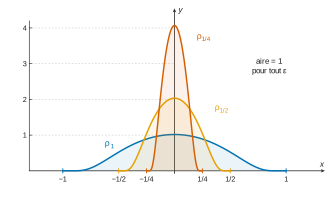
$\psi_{-1,1}$ est continue, positive, nulle hors de $[-1,1]$, donc intégrable sur $\mathbb R$ et $I=\int_{-\infty}^{+\infty}\psi_{-1,1}=\int_{-1}^1\psi_{-1,1}$. Une fonction continue positive d'intégrale nulle sur un segment est nulle ; or $\psi_{-1,1}(0)=\mathrm e^{-2}>0$. Donc $I>0$ et $\rho_\varepsilon(x)=\dfrac{1}{\varepsilon I}\psi_{-1,1}(x/\varepsilon)$ est bien définie.
$\rho_\varepsilon$ est $\mathcal C^\infty$ (composée et produit par une constante), positive, et si $|x|>\varepsilon$ alors $|x/\varepsilon|>1$ donc $\rho_\varepsilon(x)=0$. Avec $A=\varepsilon$ : **$\rho_\varepsilon\in\mathcal D(\mathbb R)$**, nulle hors de $[-\varepsilon,\varepsilon]$.
### Q6
Par le changement de variable affine $x=\varepsilon u$ :
$$\int_{-\infty}^{+\infty}\rho_\varepsilon(x)\,\mathrm dx=\frac1{\varepsilon I}\int_{-\varepsilon}^{\varepsilon}\psi_{-1,1}\!\left(\frac x\varepsilon\right)\mathrm dx=\frac1{\varepsilon I}\int_{-1}^1\psi_{-1,1}(u)\,\varepsilon\,\mathrm du=1.$$
$$\boxed{\int_{-\infty}^{+\infty}\rho_\varepsilon(x)\,\mathrm dx=1}$$
### Q7
**(a)** La fonction $\rho_\varepsilon g$ est continue et nulle hors de $[-\varepsilon,\varepsilon]$. Par Q6 et la positivité de $\rho_\varepsilon$ :
$$\left|\int_{-\infty}^{+\infty}\rho_\varepsilon g-g(0)\right|=\left|\int_{-\varepsilon}^{\varepsilon}\rho_\varepsilon(x)\big(g(x)-g(0)\big)\mathrm dx\right|\leqslant\omega(\varepsilon)\int_{-\varepsilon}^{\varepsilon}\rho_\varepsilon=\omega(\varepsilon),$$
où $\omega(\varepsilon)=\sup_{|x|\leqslant\varepsilon}|g(x)-g(0)|$ (fini : fonction continue sur un segment). Par continuité de $g$ en $0$, pour tout $\eta>0$ il existe $\alpha>0$ tel que $|x|\leqslant\alpha\Rightarrow|g(x)-g(0)|\leqslant\eta$, donc $\omega(\varepsilon)\leqslant\eta$ pour $0<\varepsilon\leqslant\alpha$. Ainsi
$$\boxed{\lim_{\varepsilon\to0^+}\int_{-\infty}^{+\infty}\rho_\varepsilon(x)g(x)\,\mathrm dx=g(0)}$$
**(b)** Par le changement de variable $t=x-a$, $\int\rho_\varepsilon(x-a)g(x)\,\mathrm dx=\int\rho_\varepsilon(t)\,g(a+t)\,\mathrm dt$. La fonction $h:t\mapsto g(a+t)$ est continue ; le (a) appliqué à $h$ donne une limite $h(0)=g(a)$ :
$$\boxed{\lim_{\varepsilon\to0^+}\int_{-\infty}^{+\infty}\rho_\varepsilon(x-a)g(x)\,\mathrm dx=g(a)}$$
## Partie B – Distribution sur $\mathbb R$
### Q8
$\mathcal D'(\mathbb R)$ est une partie de l'espace vectoriel $\mathcal F(\mathcal D(\mathbb R),\mathbb R)$ des applications de $\mathcal D(\mathbb R)$ dans $\mathbb R$. Elle contient l'application nulle (linéaire, avec $C_K=1$, $N_K=0$). Soient $T,S\in\mathcal D'(\mathbb R)$, $\lambda\in\mathbb R$ ; $T+\lambda S$ est linéaire. Pour un segment $K$, soient $(C_K,N_K)$ et $(C_K',N_K')$ les constantes de $T$ et $S$ ; avec $N=\max(N_K,N_K')$ et $C=C_K+|\lambda|C_K'>0$, pour toute $\varphi\in\mathcal D(K)$ :
$$|(T+\lambda S)(\varphi)|\leqslant C_K\max_{i\leqslant N_K}\|\varphi^{(i)}\|_\infty+|\lambda|C_K'\max_{i\leqslant N_K'}\|\varphi^{(i)}\|_\infty\leqslant C\max_{i\leqslant N}\|\varphi^{(i)}\|_\infty.$$
Donc $T+\lambda S\in\mathcal D'(\mathbb R)$ : **$\mathcal D'(\mathbb R)$ est un sous-espace vectoriel de $\mathcal F(\mathcal D(\mathbb R),\mathbb R)$, donc un espace vectoriel.**
### Q9
$\delta_a$ est linéaire : $(f+\lambda g)(a)=f(a)+\lambda g(a)$. Pour tout segment $K$ et $\varphi\in\mathcal D(K)$, $|\delta_a(\varphi)|=|\varphi(a)|\leqslant\|\varphi\|_\infty$ : $C_K=1$, $N_K=0$ conviennent. **$\delta_a\in\mathcal D'(\mathbb R)$.**
### Q10
Soit $\varphi\in\mathcal D(\mathbb R)$ nulle hors de $[-A,A]$. $f\varphi$ est continue par morceaux et nulle hors de $[-A,A]$, donc intégrable sur $\mathbb R$, et $T_f(\varphi)=\int_{-A}^Af\varphi$ : $T_f$ est bien définie, et linéaire par linéarité de l'intégrale.
Pour un segment $K$ et $\varphi\in\mathcal D(K)$ :
$$|T_f(\varphi)|=\left|\int_Kf\varphi\right|\leqslant\left(\int_K|f|\right)\|\varphi\|_\infty\leqslant C_K\|\varphi\|_\infty,\qquad C_K=1+\int_K|f|>0,\ N_K=0.$$
**$T_f\in\mathcal D'(\mathbb R)$.**
### Q11
Soit $a\in\mathbb R$ et $\varepsilon>0$. La fonction $\theta_\varepsilon:x\mapsto\rho_\varepsilon(x-a)$ est $\mathcal C^\infty$ et nulle pour $|x|>|a|+\varepsilon$, donc $\theta_\varepsilon\in\mathcal D(\mathbb R)$. L'égalité $T_{f_1}(\theta_\varepsilon)=T_{f_2}(\theta_\varepsilon)$ s'écrit
$$\int_{-\infty}^{+\infty}\rho_\varepsilon(x-a)f_1(x)\,\mathrm dx=\int_{-\infty}^{+\infty}\rho_\varepsilon(x-a)f_2(x)\,\mathrm dx.$$
$f_1$ et $f_2$ étant continues, Q7 (b) donne, quand $\varepsilon\to0^+$, $f_1(a)=f_2(a)$. Ceci pour tout $a$ : **$f_1=f_2$.**
### Q12
**(a)** Si $x\neq0$, $t\mapsto\varphi(tx)/x$ est une primitive de $t\mapsto\varphi'(tx)$ sur $[0,1]$, donc $\int_0^1\varphi'(tx)\,\mathrm dt=\dfrac{\varphi(x)-\varphi(0)}{x}=\psi(x)$. Si $x=0$, $\int_0^1\varphi'(0)\,\mathrm dt=\varphi'(0)=\psi(0)$.
$$\boxed{\forall x\in\mathbb R,\quad\psi(x)=\int_0^1\varphi'(tx)\,\mathrm dt}$$
**(b)** Soit $F(x,t)=\varphi'(tx)$ sur $\mathbb R\times[0,1]$ et $k\in\mathbb N^*$. Pour tout $t$, $x\mapsto F(x,t)$ est $\mathcal C^k$ avec $\dfrac{\partial^jF}{\partial x^j}(x,t)=t^j\varphi^{(j+1)}(tx)$ ; ces fonctions sont continues en $t$ sur le segment $[0,1]$, donc intégrables ; et
$$\left|\frac{\partial^kF}{\partial x^k}(x,t)\right|\leqslant\|\varphi^{(k+1)}\|_\infty,$$
constante intégrable sur $[0,1]$. Par le théorème de dérivation des intégrales à paramètre (classe $\mathcal C^k$), $\psi$ est $\mathcal C^k$ sur $\mathbb R$ avec $\psi^{(k)}(x)=\int_0^1t^k\varphi^{(k+1)}(tx)\,\mathrm dt$. Ceci pour tout $k$ : **$\psi\in\mathcal C^\infty(\mathbb R)$.**
### Q13
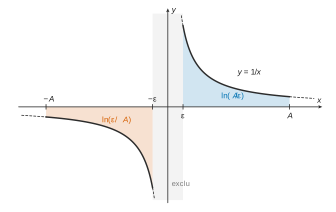
**(a)** Soit $\varphi\in\mathcal D(\mathbb R)$ nulle hors de $[-A,A]$, et $0<\varepsilon<A$. Les intégrales $\int_{-\infty}^{-\varepsilon}\frac{\varphi(x)}x\mathrm dx=\int_{-A}^{-\varepsilon}\frac{\varphi(x)}x\mathrm dx$ et $\int_\varepsilon^{+\infty}\frac{\varphi(x)}x\mathrm dx=\int_\varepsilon^A\frac{\varphi(x)}x\mathrm dx$ existent (fonctions continues sur des segments). Pour $x\neq0$, $\dfrac{\varphi(x)}x=\dfrac{\varphi(0)}x+\psi(x)$, et
$$\int_{-A}^{-\varepsilon}\frac{\mathrm dx}x+\int_\varepsilon^A\frac{\mathrm dx}x=\ln\frac\varepsilon A+\ln\frac A\varepsilon=0.$$
Donc
$$J(\varepsilon)=\int_{-A}^{-\varepsilon}\psi+\int_\varepsilon^A\psi=\int_{-A}^A\psi-\int_{-\varepsilon}^\varepsilon\psi.$$
$\psi$ est continue (Q12), donc bornée par $M$ sur $[-A,A]$, et $\left|\int_{-\varepsilon}^\varepsilon\psi\right|\leqslant2\varepsilon M\to0$. La limite existe :
$$\boxed{V(\varphi)=\int_{-A}^A\psi(x)\,\mathrm dx=\int_{-A}^{A}\frac{\varphi(x)-\varphi(0)}{x}\,\mathrm dx}$$
(pour tout $A$ tel que $\varphi$ soit nulle hors de $[-A,A]$).
**(b)** *Linéarité.* Pour $\varepsilon>0$, $J_\varepsilon:\varphi\mapsto\int_{-\infty}^{-\varepsilon}\frac\varphi x+\int_\varepsilon^{+\infty}\frac\varphi x$ est linéaire ; les limites existant, $V=\lim J_\varepsilon$ est linéaire.
*Estimation.* Soit $K=[\alpha,\beta]$ et $a=\max(1,|\alpha|,|\beta|)$, de sorte que $K\subset[-a,a]$. Pour $\varphi\in\mathcal D(K)$, (a) donne $V(\varphi)=\int_{-a}^a\psi$, et par Q12 (a), $|\psi(x)|\leqslant\int_0^1|\varphi'(tx)|\,\mathrm dt\leqslant\|\varphi'\|_\infty$. D'où
$$|V(\varphi)|\leqslant2a\|\varphi'\|_\infty\leqslant2a\max_{i\in[\![0,1]\!]}\|\varphi^{(i)}\|_\infty.$$
$C_K=2a>0$, $N_K=1$ conviennent : **$V\in\mathcal D'(\mathbb R)$.**
## Partie C – Dérivation d'une distribution
### Q14
Si $\varphi\in\mathcal D(K)$ ($K$ segment), $\varphi$ est nulle sur l'ouvert $\mathbb R\setminus K$, donc $\varphi'$ aussi : $\varphi'\in\mathcal D(K)$. En particulier $\varphi'\in\mathcal D(\mathbb R)$ pour toute $\varphi\in\mathcal D(\mathbb R)$, $T'$ est bien définie, et elle est linéaire comme composée de $\varphi\mapsto\varphi'$ et de $-T$. Avec les constantes $(C_K,N_K)$ de $T$ :
$$|T'(\varphi)|=|T(\varphi')|\leqslant C_K\max_{0\leqslant i\leqslant N_K}\|\varphi^{(i+1)}\|_\infty\leqslant C_K\max_{0\leqslant i\leqslant N_K+1}\|\varphi^{(i)}\|_\infty.$$
$(C_K,N_K+1)$ convient : **$T'\in\mathcal D'(\mathbb R)$.**
### Q15
Soit $\varphi\in\mathcal D(\mathbb R)$ nulle hors de $[-A,A]$. $f$ et $\varphi$ sont $\mathcal C^1$ sur $[-A,A]$ ; par intégration par parties et $\varphi(\pm A)=0$ :
$$T_f'(\varphi)=-\int_{-A}^Af\varphi'=-\big[f\varphi\big]_{-A}^A+\int_{-A}^Af'\varphi=\int_{-\infty}^{+\infty}f'\varphi=T_{f'}(\varphi).$$
$$\boxed{T_f'=T_{f'}}$$
### Q16
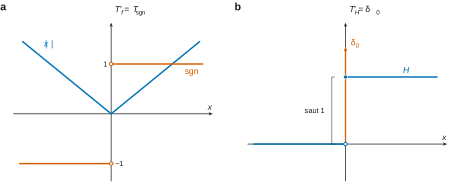
**(a)** Le taux d'accroissement $\dfrac{|x|-0}{x}$ vaut $1$ pour $x>0$ et $-1$ pour $x<0$ : il n'a pas de limite en $0$. **$f$ n'est pas dérivable en $0$, donc pas sur $\mathbb R$.**
**(b)** Soit $\varphi\in\mathcal D(\mathbb R)$ nulle hors de $[-A,A]$. Par intégrations par parties sur $[-A,0]$ et $[0,A]$ (les crochets sont nuls en $0$ grâce au facteur $x$ et en $\pm A$ car $\varphi(\pm A)=0$) :
$$\int_0^Ax\varphi'(x)\,\mathrm dx=-\int_0^A\varphi,\qquad\int_{-A}^0(-x)\varphi'(x)\,\mathrm dx=\int_{-A}^0\varphi.$$
Donc $T_f'(\varphi)=-\int_{-A}^A|x|\varphi'(x)\,\mathrm dx=\int_0^A\varphi-\int_{-A}^0\varphi$. Avec $\operatorname{sgn}(x)=1$ si $x>0$, $-1$ si $x<0$, $0$ si $x=0$ (fonction continue par morceaux) :
$$\boxed{T_f'=T_{\operatorname{sgn}}:\quad T_f'(\varphi)=\int_{-\infty}^{+\infty}\operatorname{sgn}(x)\varphi(x)\,\mathrm dx}$$
(la valeur en $0$ est indifférente).
### Q17
$H$ est constante sur $]-\infty,0[$ et sur $[0,+\infty[$, avec des limites finies à gauche et à droite en $0$ : sur tout segment, elle a au plus une discontinuité, avec limites finies, donc elle est continue par morceaux. Pour $\varphi\in\mathcal D(\mathbb R)$ nulle hors de $[-A,A]$ :
$$T_H'(\varphi)=-\int_0^A\varphi'(x)\,\mathrm dx=-\big(\varphi(A)-\varphi(0)\big)=\varphi(0)=\delta_0(\varphi).$$
$$\boxed{T_H'=\delta_0}$$
### Q18
**(a)** $T'=0$ signifie $T'(\varphi)=-T(\varphi')=0$ pour toute $\varphi\in\mathcal D(\mathbb R)$, d'où **$T(\varphi')=0$.**
**(b)** Soit $\varphi$ nulle hors de $[-A,A]$ et d'intégrale nulle, et $\psi(x)=\int_{-\infty}^x\varphi(t)\,\mathrm dt$ (intégrale d'une fonction continue à support borné). $\psi$ est la primitive de $\varphi$ nulle en $-A$, donc $\psi'=\varphi$ et $\psi\in\mathcal C^\infty(\mathbb R)$. Pour $x\leqslant-A$, $\psi(x)=0$ ; pour $x\geqslant A$, $\psi(x)=\int_{-\infty}^{+\infty}\varphi=0$. Donc $\psi\in\mathcal D(\mathbb R)$ et, par (a), **$T(\varphi)=T(\psi')=0$.**
**(c)** $\varphi_0=\rho_1$ convient : $\rho_1\in\mathcal D(\mathbb R)$ (Q5) et $\int\rho_1=1$ (Q6).
**(d)** Soit $\alpha=\int\varphi$ et $\chi=\varphi-\alpha\varphi_0\in\mathcal D(\mathbb R)$, d'intégrale $\alpha-\alpha=0$. Par (b), $T(\chi)=0$, et par linéarité :
$$\boxed{T(\varphi)=\alpha\,T(\varphi_0)=T(\varphi_0)\int_{-\infty}^{+\infty}\varphi(t)\,\mathrm dt}$$
**(e)** Soit $h$ la fonction constante égale à $c=T(\varphi_0)$, continue. Pour toute $\varphi$, $T_h(\varphi)=c\int\varphi=T(\varphi)$ par (d). **$T=T_h$ avec $h$ constante.**
### Q19
Si $T_f'=0$ avec $f$ continue, Q18 (e) donne une constante $h$ telle que $T_f=T_h$ ; $f$ et $h$ étant continues, Q11 donne $f=h$. Réciproquement, si $f$ est constante, Q15 donne $T_f'=T_{f'}=T_0=0$. **Les solutions sont les fonctions constantes.**
### Q20
Soit $f$ continue telle que $T_f''=(T_f')'=0$. Comme $T_f'\in\mathcal D'(\mathbb R)$ (Q14), Q18 (e) fournit $c\in\mathbb R$ tel que $T_f'=T_c$. Soit $g:x\mapsto cx$, de classe $\mathcal C^1$ : $T_g'=T_{g'}=T_c$ (Q15). Les applications $u\mapsto T_u$ et $T\mapsto T'$ étant linéaires,
$$(T_{f-g})'=T_f'-T_g'=0.$$
$f-g$ est continue, donc constante égale à un réel $d$ par Q19 : $f(x)=cx+d$. Réciproquement, si $f$ est affine, deux applications de Q15 donnent $T_f''=(T_{f'})'=T_{f''}=T_0=0$.
$$\boxed{\{f\in\mathcal C^0(\mathbb R,\mathbb R):T_f''=0\}=\{x\mapsto cx+d,\ (c,d)\in\mathbb R^2\}}$$
### Q21
$g$ est continue sur l'intervalle $\mathbb R$ ; par le théorème fondamental de l'analyse, $G:x\mapsto\int_0^xg(t)\,\mathrm dt$ est de classe $\mathcal C^1$ sur $\mathbb R$ et **$G'=g$**.
### Q22
$G$ étant $\mathcal C^1$, Q15 donne $T_G'=T_{G'}=T_g$. Par linéarité de la dérivation et l'hypothèse $T_f'=T_g$ : $(T_f-T_G)'=T_g-T_g=0$.
$$\boxed{(T_f-T_G)'=0}$$
### Q23
$T_f-T_G=T_{f-G}$ et $f-G$ est continue ; par Q22 et Q19, $f-G$ est une constante $c$. Donc $f=G+c$ :
$$\boxed{f\in\mathcal C^1(\mathbb R)\quad\text{et}\quad f'=g}$$
## Partie D – Suite de distributions
### Q24
Soit $\varphi\in\mathcal D(\mathbb R)$ ; $\varphi'\in\mathcal D(\mathbb R)$ (Q14), donc $T_n(\varphi')\to T(\varphi')$ et
$$T_n'(\varphi)=-T_n(\varphi')\longrightarrow-T(\varphi')=T'(\varphi).$$
**$\lim T_n'\overset{\mathcal D}{=}T'$.**
### Q25
On prend $f_n(x)=\cos(nx)$, continue.
- En $x=\pi$, $f_n(\pi)=(-1)^n$ n'a pas de limite : $(f_n)$ ne converge pas simplement sur $\mathbb R$.
- Pour $\varphi\in\mathcal D(\mathbb R)$ nulle hors de $[-A,A]$ et $n\geqslant1$, par intégration par parties ($\varphi(\pm A)=0$) :
$$T_{f_n}(\varphi)=\int_{-A}^A\cos(nx)\varphi(x)\,\mathrm dx=\left[\frac{\sin(nx)}n\varphi(x)\right]_{-A}^A-\frac1n\int_{-A}^A\sin(nx)\varphi'(x)\,\mathrm dx,$$
donc $|T_{f_n}(\varphi)|\leqslant\dfrac{2A\|\varphi'\|_\infty}{n}\to0$.
**La suite $(x\mapsto\cos(nx))_n$ convient** : elle ne converge pas simplement et $\lim T_{f_n}\overset{\mathcal D}{=}0$.
### Q26
Pour $\varphi\in\mathcal D(\mathbb R)$ nulle hors de $[-A,A]$, et $n$ assez grand pour que $f_n-f$ soit bornée :
$$|T_{f_n}(\varphi)-T_f(\varphi)|\leqslant\int_{-A}^A|f_n-f|\,|\varphi|\leqslant2A\|\varphi\|_\infty\|f_n-f\|_\infty\xrightarrow[n\to+\infty]{}0.$$
**$\lim T_{f_n}\overset{\mathcal D}{=}T_f$.**
### Q27
Pour $\varphi\in\mathcal D(\mathbb R)$ nulle hors de $[-A,A]$, l'inégalité de Cauchy-Schwarz sur le segment $[-A,A]$ et la positivité de $(f_n-f)^2$ donnent
$$|T_{f_n}(\varphi)-T_f(\varphi)|\leqslant\left(\int_{-A}^A(f_n-f)^2\right)^{1/2}\left(\int_{-A}^A\varphi^2\right)^{1/2}\leqslant\|f_n-f\|_2\left(\int_{-A}^A\varphi^2\right)^{1/2}\xrightarrow[n\to+\infty]{}0.$$
**$\lim T_{f_n}\overset{\mathcal D}{=}T_f$.**
## Partie E – Une application, le théorème d'unicité de Cantor
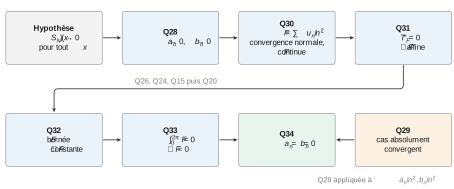
On note $u_n(x)=a_n\cos(nx)+b_n\sin(nx)$ et $S_N=\sum_{n=1}^Nu_n$ ; par hypothèse, $S_N(x)\to0$ pour tout $x\in\mathbb R$.
### Q28
**(a)** En $x=0$, $u_n(0)=a_n$ ; la série $\sum a_n$ converge, donc son terme général tend vers $0$ : **$a_n\to0$.**
**(b)** Pour tout $x$, $u_n(x)\to0$ (terme général d'une série convergente) et $|a_n\cos(nx)|\leqslant|a_n|\to0$. Par différence, **$b_n\sin(nx)\to0$ pour tout $x\in\mathbb R$**, en particulier sur $[0,2\pi]$.
**(c)** Si $(b_n)$ ne tend pas vers $0$, il existe $\varepsilon>0$ tel que $|b_n|\geqslant\varepsilon$ pour une infinité d'indices $n$. Il y a alors une infinité d'indices avec $b_n\geqslant\varepsilon$, ou une infinité avec $b_n\leqslant-\varepsilon$ ; dans le second cas, on remplace $(a_n,b_n)$ par $(-a_n,-b_n)$, ce qui conserve l'hypothèse (série convergente de somme nulle en tout point) et ne change pas la convergence de $(b_n)$ vers $0$. L'ensemble $E=\{n\in\mathbb N^*:b_n\geqslant\varepsilon\}$ est donc infini. On définit par récurrence $\varphi(0)=\min E$ et $\varphi(n+1)=\min\{m\in E:m>\varphi(n)\}$, qui existe car $E$ est infini. Alors **$\varphi:\mathbb N\to\mathbb N^*$ est strictement croissante et $b_{\varphi(n)}\geqslant\varepsilon$ pour tout $n$.**
**(d)** Soit $x\in[0,2\pi]$. La suite $\big(b_{\varphi(n)}\sin(\varphi(n)x)\big)_n$ est extraite de $\big(b_m\sin(mx)\big)_m$, qui tend vers $0$ par (b). Comme $b_{\varphi(n)}^2\geqslant\varepsilon^2$,
$$0\leqslant\sin^2(\varphi(n)x)\leqslant\frac{\big(b_{\varphi(n)}\sin(\varphi(n)x)\big)^2}{\varepsilon^2}\longrightarrow0.$$
Les fonctions continues $g_n:x\mapsto\sin^2(\varphi(n)x)$ convergent donc simplement vers $0$ sur $[0,2\pi]$ et vérifient $|g_n|\leqslant1$, fonction intégrable sur le segment. Par le théorème de convergence dominée :
$$\boxed{\lim_{n\to+\infty}\int_0^{2\pi}\sin^2(\varphi(n)x)\,\mathrm dx=0}$$
**(e)** Pour $k\in\mathbb N^*$, $\displaystyle\int_0^{2\pi}\sin^2(kx)\,\mathrm dx=\int_0^{2\pi}\frac{1-\cos(2kx)}2\,\mathrm dx=\pi$. La suite du (d) est donc constante égale à $\pi\neq0$ : contradiction. **Donc $b_n\to0$**, et avec (a), $a_n\to0$ et $b_n\to0$.
### Q29
Pour tout $x$, $|u_n(x)|\leqslant|a_n|+|b_n|$, terme général d'une série convergente : $\sum u_n$ converge normalement, donc uniformément, sur $\mathbb R$, de somme nulle. Pour $k\in\mathbb N^*$, $\sum u_n\cos(k\,\cdot)$ converge uniformément sur $[0,2\pi]$ (car $|\cos|\leqslant1$), avec des termes continus ; on peut intégrer terme à terme sur ce segment. Par linéarisation, pour $n,k\in\mathbb N^*$ (avec $n+k\neq0$) :
$$\int_0^{2\pi}\cos(nx)\cos(kx)\,\mathrm dx=\pi\,\delta_{n,k},\quad\int_0^{2\pi}\sin(nx)\cos(kx)\,\mathrm dx=0,\quad\int_0^{2\pi}\sin(nx)\sin(kx)\,\mathrm dx=\pi\,\delta_{n,k}.$$
Donc
$$0=\int_0^{2\pi}\Big(\sum_{n=1}^{+\infty}u_n(x)\Big)\cos(kx)\,\mathrm dx=\sum_{n=1}^{+\infty}\int_0^{2\pi}u_n(x)\cos(kx)\,\mathrm dx=\pi a_k,$$
et de même avec $\sin(kx)$ : $0=\pi b_k$.
$$\boxed{\forall n\in\mathbb N^*,\quad a_n=b_n=0}$$
### Q30
Par Q28, $(a_n)$ et $(b_n)$ convergent, donc sont bornées : il existe $M>0$ tel que $|a_n|+|b_n|\leqslant M$ pour tout $n$. Alors, pour tout $x\in\mathbb R$,
$$|f_n(x)|\leqslant\frac{|a_n|+|b_n|}{n^2}\leqslant\frac M{n^2},$$
terme général d'une série de Riemann convergente : **$\sum f_n$ converge normalement sur $\mathbb R$.** En particulier la convergence est uniforme et $F$ est continue sur $\mathbb R$.
### Q31
Soit $F_N=\sum_{n=1}^Nf_n$, de classe $\mathcal C^\infty$, avec $F_N''=-\sum_{n=1}^N u_n=-S_N$. Deux applications de Q15 (à $F_N$ puis à $F_N'$) donnent $T_{F_N}''=T_{F_N''}=-T_{S_N}$.
$(F_N)$ converge uniformément vers $F$ sur $\mathbb R$ (Q30), donc $\lim T_{F_N}\overset{\mathcal D}{=}T_F$ (Q26), puis $\lim T_{F_N}''\overset{\mathcal D}{=}T_F''$ (Q24 appliquée deux fois). Pour toute $\varphi\in\mathcal D(\mathbb R)$ nulle hors de $[-A,A]$ :
$$T_F''(\varphi)=-\lim_{N\to+\infty}\int_{-A}^AS_N(x)\varphi(x)\,\mathrm dx.$$
Par hypothèse, $S_N\varphi\to0$ simplement sur $[-A,A]$. En passant à la limite sous l'intégrale, on obtient $T_F''(\varphi)=0$, donc $T_F''=0$. $F$ étant continue (Q30), Q20 donne :
$$\boxed{F\text{ est affine : }F(x)=cx+d}$$
*Réserve.* Le passage à la limite sous l'intégrale est le point que le sujet admet implicitement : la convergence simple de $(S_N)$ ne suffit pas, et le théorème de convergence dominée exige une majoration $|S_N|\leqslant g$ sur $[-A,A]$, avec $g$ intégrable indépendante de $N$, que l'énoncé ne fournit pas. Cette majoration existe sous l'hypothèse de Q29 ($|S_N|\leqslant\sum(|a_n|+|b_n|)$). Dans le cas général, une preuve complète passe par les lemmes de Riemann et de Schwarz sur les dérivées secondes symétriques, hors programme.
### Q32
Pour tout $x$, $|F(x)|\leqslant\sum_{n\geqslant1}M/n^2=M\pi^2/6$ : **$F$ est bornée.** Si $F(x)=cx+d$ avec $c\neq0$, $|F(x)|\to+\infty$ quand $x\to+\infty$, ce qui est absurde. Donc $c=0$ : **$F$ est constante, égale à $d$.**
### Q33
$\sum f_n$ converge uniformément sur le segment $[0,2\pi]$ et ses termes sont continus : on peut intégrer terme à terme. Comme $\int_0^{2\pi}\cos(nx)\,\mathrm dx=\int_0^{2\pi}\sin(nx)\,\mathrm dx=0$ pour $n\geqslant1$,
$$2\pi d=\int_0^{2\pi}F(x)\,\mathrm dx=\sum_{n=1}^{+\infty}\int_0^{2\pi}f_n(x)\,\mathrm dx=0.$$
Donc $d=0$ : **$F=0$.**
### Q34
Posons $\alpha_n=a_n/n^2$ et $\beta_n=b_n/n^2$. La série $\sum(\alpha_n\cos(nx)+\beta_n\sin(nx))=\sum f_n(x)$ converge pour tout $x$, de somme $F(x)=0$ (Q30, Q33), et $|\alpha_n|,|\beta_n|\leqslant M/n^2$, donc $\sum|\alpha_n|$ et $\sum|\beta_n|$ convergent. Q29 s'applique à $(\alpha_n)$, $(\beta_n)$ : $\alpha_n=\beta_n=0$, donc
$$\boxed{\forall n\in\mathbb N^*,\quad a_n=b_n=0}$$
**Conclusion (théorème d'unicité de Cantor).** Une série trigonométrique $\sum_{n\geqslant1}(a_n\cos(nx)+b_n\sin(nx))$ qui converge vers $0$ en tout point de $\mathbb R$ a tous ses coefficients nuls. Par différence, deux séries trigonométriques convergeant en tout point vers la même somme ont les mêmes coefficients : un développement trigonométrique partout convergent est unique.
Aide sur le corrigé
Connectez-vous pour demander une explication.