Maths 1
Centrale-SupélecMP2026
Rédigé par IA, non vérifié
Signaler une erreur# Centrale-Supélec MP-MPI — Mathématiques 1 2026 · Corrigé brut
*Corrigé rédigé par IA (La Belle Copie), non officiel. Signalez toute erreur.*
**Sur quelques sous-groupes de $\mathrm{GL}_n(\mathbb{R})$.** Épreuve de 4 heures, calculatrice autorisée. Trois parties indépendantes. Notations : $E_{k\ell}$ désigne la base canonique de $\mathcal{M}_n(\mathbb{R})$ et $\|M\|=\sqrt{\operatorname{tr}(M^\top M)}$ la norme euclidienne canonique de $\mathcal{M}_n(\mathbb{R})$ (toutes les normes y sont équivalentes).
Trois énoncés ne sont pas exacts tels quels : **Q6.a** (il manque l'hypothèse $2\pi\in\theta\mathbb{Z}+\theta'\mathbb{Z}$), **Q38** (la majoration $|z|\leqslant|ij|$ est fausse en général) et **Q39** (il faut que $k$ soit du signe de $ij$). Chaque fois, un contre-exemple est donné et la conclusion utile pour la suite est démontrée.
---
## Partie A — Sous-groupes finis de $\mathrm{O}_n(\mathbb{R})$
### I — Généralités
#### Q1
Supposons $G$ fini, de cardinal $N\geqslant 1$.
*Trace.* $\operatorname{tr}G$ est l'image de l'ensemble fini $G$ par l'application $\operatorname{tr}$, donc $|\operatorname{tr}G|\leqslant N$ : **$\operatorname{tr}G$ est fini.**
*Exposant.* Soit $x\in G$. Le sous-groupe $\langle x\rangle\subset G$ est fini, donc $x$ est d'ordre fini $d_x=|\langle x\rangle|$, et l'ordre d'un élément d'un groupe fini divise le cardinal du groupe : $d_x\mid N$. En écrivant $N=d_xq$, on obtient $x^N=(x^{d_x})^q=I_n$. Avec $m=N\in\mathbb{N}^*$ (indépendant de $x$), $\forall x\in G,\ x^m=I_n$ : **$G$ est d'exposant fini.**
(Sans ce théorème, $m=\operatorname{ppcm}(d_x)_{x\in G}$, ou $m=N!$, convient aussi, puisque chaque $d_x\leqslant N$.)
#### Q2
Pour $t\in\mathbb{R}$, posons $M_t=I_n+tE_{12}$ (ce qui a un sens car $n\geqslant2$). Comme $E_{12}^2=0$, $M_tM_s=M_{t+s}$. Donc $M_0=I_n$, l'ensemble $G=\{M_t\,;\,t\in\mathbb{R}\}$ est stable par produit, et $M_t^{-1}=M_{-t}\in G$ : $G$ est un sous-groupe de $\mathrm{GL}_n(\mathbb{R})$. L'application $t\mapsto M_t$ est injective (coefficient $(1,2)$), donc $G$ est infini. Enfin $M_t$ est triangulaire à diagonale unité, donc
$$\boxed{G=\{I_n+tE_{12}\,;\,t\in\mathbb{R}\}\ \text{est infini et}\ \operatorname{tr}G=\{n\}.}$$
#### Q3
Soit $G$ l'ensemble des applications de $\mathbb{N}$ dans $\mathbb{Z}/2\mathbb{Z}$, muni de l'addition point par point. C'est un groupe commutatif (axiomes vérifiés point par point, neutre la fonction nulle). Les fonctions $\delta_k$ (valant $\bar1$ en $k$, $\bar0$ ailleurs) sont deux à deux distinctes, donc $G$ est infini. Pour tout $f\in G$, $f+f=0$. Donc
$$\boxed{G=(\mathbb{Z}/2\mathbb{Z})^{\mathbb{N}}\ \text{est infini et d'exposant }2.}$$
(Variante : les parties de $\mathbb{N}$ munies de la différence symétrique.)
### II — Cas particulier : les sous-groupes finis de $\mathrm{O}_2(\mathbb{R})$
#### Q4
*Existence.* Soit $A=\begin{pmatrix}a&c\\b&d\end{pmatrix}\in\mathrm{SO}_2(\mathbb{R})$. Les colonnes $C_1=(a,b)$, $C_2=(c,d)$ forment une famille orthonormée de $\mathbb{R}^2$. Comme $a^2+b^2=1$, il existe un unique $\theta\in[0,2\pi[$ tel que $a=\cos\theta$, $b=\sin\theta$. Le vecteur $C_2$ est unitaire et orthogonal à $C_1$ ; or $C_1^\perp=\mathbb{R}(-b,a)$ avec $(-b,a)$ unitaire, donc $C_2=\lambda(-b,a)$, $\lambda=\pm1$. Enfin $1=\det A=ad-bc=\lambda(a^2+b^2)=\lambda$, donc $A=R_\theta$.
*Unicité.* Si $R_\theta=R_{\theta'}$ avec $\theta,\theta'\in[0,2\pi[$, alors $\cos\theta=\cos\theta'$ et $\sin\theta=\sin\theta'$, donc $\theta-\theta'\in2\pi\mathbb{Z}$ ; comme $|\theta-\theta'|<2\pi$, $\theta=\theta'$.
**Tout $A\in\mathrm{SO}_2(\mathbb{R})$ s'écrit de façon unique $R_\theta$ avec $\theta\in[0,2\pi[$.**
#### Q5
**a)** Par récurrence, $R_\theta^k=R_{k\theta}$ pour $k\in\mathbb{N}$, et $R_\theta^{-1}=R_{-\theta}$, d'où $R_\theta^k=R_{k\theta}$ pour $k\in\mathbb{Z}$. L'ensemble $H=\{R_{k\theta}\,;\,k\in\mathbb{Z}\}$ contient $I_2$, est stable par produit ($R_{k\theta}R_{\ell\theta}=R_{(k+\ell)\theta}$) et par inverse : c'est un sous-groupe contenant $R_\theta$, donc $G\subset H$. Inversement $R_{k\theta}=R_\theta^k\in G$. **Donc $G=\{R_{k\theta}\,;\,k\in\mathbb{Z}\}$.**
**b)** Pour $\theta=2\pi/m$ : $R_{k\theta}=R_{\ell\theta}\iff 2\pi(k-\ell)/m\in2\pi\mathbb{Z}\iff m\mid k-\ell$. L'application $\bar k\mapsto R_{k\theta}$ de $\mathbb{Z}/m\mathbb{Z}$ dans $G$ est bien définie, injective, et surjective par a) :
$$\boxed{|G|=m.}$$
**c)** Si $\theta/\pi=a/b$ avec $a\in\mathbb{Z}$, $b\in\mathbb{N}^*$, alors $2b\theta=2a\pi$, donc $R_\theta^{2b}=I_2$ ; par division euclidienne $k=2bq+r$, $R_{k\theta}=R_{r\theta}$ avec $0\leqslant r<2b$ : $|G|\leqslant2b$, $G$ est fini.
Réciproquement, si $G$ est fini, $k\mapsto R_{k\theta}$ n'est pas injective sur $\mathbb{Z}$ : il existe $k<\ell$ avec $R_{(\ell-k)\theta}=I_2$, donc $(\ell-k)\theta=2s\pi$ ($s\in\mathbb{Z}$) et $\theta/\pi=2s/(\ell-k)\in\mathbb{Q}$.
$$\boxed{G\ \text{fini}\iff\theta/\pi\in\mathbb{Q}.}$$
**d)** Si $x^m=I_2$ pour tout $x\in G$, alors $R_{m\theta}=I_2$, donc $m\theta=2s\pi$ et $\theta/\pi=2s/m\in\mathbb{Q}$ : **$G$ est fini** par c).
**e)** Supposons $\operatorname{tr}G$ fini. Tout élément de $G$ s'écrit de façon unique $R_\varphi$, $\varphi\in[0,2\pi[$ (Q4), de trace $2\cos\varphi$. Pour $t\in\operatorname{tr}G$, l'équation $\cos\varphi=t/2$ a au plus deux solutions dans $[0,2\pi[$, donc la fibre $F_t=\{A\in G\,;\,\operatorname{tr}A=t\}$ a au plus deux éléments. Comme $G$ est la réunion disjointe des $F_t$,
$$|G|\leqslant2\,|\operatorname{tr}G|<+\infty:\quad\textbf{G est fini.}$$
#### Q6
**a)** Posons $\Lambda=\theta\mathbb{Z}+\theta'\mathbb{Z}$, sous-groupe de $(\mathbb{R},+)$. Les rotations commutent et $R_\theta^aR_{\theta'}^b=R_{a\theta+b\theta'}$ ; l'ensemble $\{R_\varphi\,;\,\varphi\in\Lambda\}$ est un sous-groupe (contient $R_0$, stable par produit et inverse) contenant $R_\theta,R_{\theta'}$, et tout sous-groupe contenant $R_\theta,R_{\theta'}$ le contient. Donc $G=\{R_\varphi\,;\,\varphi\in\Lambda\}$.
Posons $\Lambda'=\Lambda+2\pi\mathbb{Z}$. Comme $R_{\varphi+2k\pi}=R_\varphi$, on a aussi $G=\{R_\varphi\,;\,\varphi\in\Lambda'\}$. L'application $u:\Lambda'\cap[0,2\pi[\,\to G$, $\varphi\mapsto R_\varphi$ est injective (unicité de Q4) et surjective : pour $\varphi\in\Lambda'$, $r=\varphi-2\pi\lfloor\varphi/2\pi\rfloor\in\Lambda'\cap[0,2\pi[$ et $R_r=R_\varphi$. Donc
$$\boxed{|G|=\bigl|(\theta\mathbb{Z}+\theta'\mathbb{Z}+2\pi\mathbb{Z})\cap[0,2\pi[\bigr|}$$
et **lorsque $2\pi\in\theta\mathbb{Z}+\theta'\mathbb{Z}$**, $\Lambda'=\Lambda$, ce qui donne la formule de l'énoncé $|G|=|(\theta\mathbb{Z}+\theta'\mathbb{Z})\cap[0,2\pi[|$.
*L'hypothèse ne peut pas être omise* : pour $\theta=\theta'=4\pi/3$, $\Lambda\cap[0,2\pi[\,=\{0,4\pi/3\}$ a deux éléments, alors que $G=\langle R_{4\pi/3}\rangle=\{I_2,R_{2\pi/3},R_{4\pi/3}\}$ en a trois. De même pour $\theta=\theta'=1$, $\Lambda\cap[0,2\pi[$ a sept éléments mais $G$ est infini (Q5.c, $1/\pi\notin\mathbb{Q}$). La formule de l'énoncé est donc à lire sous l'hypothèse $2\pi\in\Lambda$, satisfaite en b) et c).
**b)** Soient $p,q$ entiers non nuls premiers entre eux. Comme $R_{-\pi/p}=R_{\pi/p}^{-1}$ engendre le même groupe, on peut supposer $p,q\geqslant1$ (dans le cas général, remplacer $p,q$ par $|p|,|q|$). Par Bézout, $p\mathbb{Z}+q\mathbb{Z}=\mathbb{Z}$, donc
$$\Lambda=\frac{\pi}{p}\mathbb{Z}+\frac{\pi}{q}\mathbb{Z}=\frac{\pi}{pq}(q\mathbb{Z}+p\mathbb{Z})=\frac{\pi}{pq}\mathbb{Z}.$$
En particulier $2\pi=2pq\cdot\frac{\pi}{pq}\in\Lambda$ et a) s'applique : $\Lambda\cap[0,2\pi[\,=\{k\pi/(pq)\,;\,0\leqslant k<2pq\}$, d'où
$$\boxed{\bigl|\langle R_{\pi/p},R_{\pi/q}\rangle\bigr|=2pq\quad(=2|pq|\ \text{si l'on autorise des signes}).}$$
**c)** Soit $g=p\wedge q$ (avec $p,q\geqslant1$, quitte à changer les signes), $p=gp'$, $q=gq'$, $p'\wedge q'=1$. Alors $\Lambda=\frac{\pi}{gp'q'}(q'\mathbb{Z}+p'\mathbb{Z})=\frac{\pi}{gp'q'}\mathbb{Z}=\frac{\pi}{p\vee q}\mathbb{Z}$, qui contient $2\pi$. Par a),
$$\boxed{\bigl|\langle R_{\pi/p},R_{\pi/q}\rangle\bigr|=2\,(|p|\vee|q|)=\frac{2|pq|}{p\wedge q}.}$$
#### Q7
Soit $G$ un sous-groupe fini de $\mathrm{SO}_2(\mathbb{R})$. Par Q4, $G=\{R_\vartheta\,;\,\vartheta\in\Theta\}$ avec $\Theta\subset[0,2\pi[$ fini, contenant $0$. Si $\Theta=\{0\}$, $G=\langle I_2\rangle$. Sinon $\Theta\cap\,]0,2\pi[$ est fini non vide et admet un plus petit élément $\alpha$. Soit $\vartheta\in\Theta$, $k=\lfloor\vartheta/\alpha\rfloor$, $r=\vartheta-k\alpha\in[0,\alpha[$. Alors $R_r=R_\vartheta R_\alpha^{-k}\in G$ et $r\in[0,2\pi[$, donc $r\in\Theta$ ; par minimalité de $\alpha$, $r=0$ et $R_\vartheta=R_\alpha^k$. Donc
$$\boxed{G=\langle R_\alpha\rangle\ \text{est monogène.}}$$
#### Q8
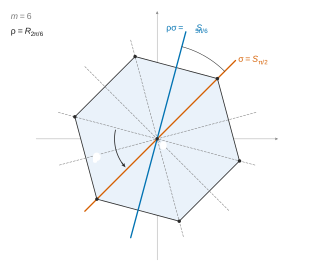
**a)** Posons $\rho=R_{2\pi/m}$, $\sigma=S_{\pi/2}$, $\mathcal{C}=\langle\rho\rangle=\{R_{2k\pi/m}\,;\,0\leqslant k<m\}$, de cardinal $m$ (Q5.b), et $\mathcal{D}=\mathcal{C}\cup\mathcal{C}\sigma$, où $\mathcal{C}\sigma=\{S_{\pi/2+2k\pi/m}\}$ (car $R_\varphi S_{\pi/2}=S_{\varphi+\pi/2}$).
$\mathcal{D}$ est un sous-groupe : il contient $I_2$ ; avec $\varphi,\psi\in\frac{2\pi}{m}\mathbb{Z}$ et $\varphi',\psi'\in\frac{\pi}{2}+\frac{2\pi}{m}\mathbb{Z}$, les relations données donnent $R_\varphi R_\psi=R_{\varphi+\psi}\in\mathcal{C}$, $R_\varphi S_{\psi'}=S_{\varphi+\psi'}\in\mathcal{C}\sigma$, $S_{\psi'}R_\varphi=S_{\psi'-\varphi}\in\mathcal{C}\sigma$, $S_{\varphi'}S_{\psi'}=R_{\varphi'-\psi'}\in\mathcal{C}$ ; enfin $R_\varphi^{-1}=R_{-\varphi}$ et $S_{\varphi'}^2=R_0=I_2$. Comme $\mathcal{D}$ contient $\rho,\sigma$ et que tout sous-groupe contenant $\rho,\sigma$ contient $\mathcal{C}$ et $\mathcal{C}\sigma$, $\mathcal{D}_m=\mathcal{D}$.
Comme $\det R_\varphi=1$ et $\det S_\varphi=-1$ : $\mathcal{D}_m\cap\mathrm{SO}_2(\mathbb{R})=\mathcal{C}=\langle R_{2\pi/m}\rangle$ et $\mathcal{D}_m\setminus\mathrm{SO}_2(\mathbb{R})=\mathcal{C}\sigma$. L'application $A\mapsto A\sigma$ est une bijection de $\mathcal{C}$ sur $\mathcal{C}\sigma$ (réciproque $B\mapsto B\sigma$, car $\sigma^2=I_2$). Donc
$$\boxed{|\mathcal{D}_m|=2m.}$$
**b)** Soit $G$ fini, $G\not\subset\mathrm{SO}_2(\mathbb{R})$, et $H=G\cap\mathrm{SO}_2(\mathbb{R})$, sous-groupe fini de $\mathrm{SO}_2(\mathbb{R})$, donc $H=\langle R_\alpha\rangle$ (Q7), de cardinal $m$. L'ordre de $R_\alpha$ vaut $m$, donc $R_{m\alpha}=I_2$ et $\alpha\in\frac{2\pi}{m}\mathbb{Z}$ ; ainsi $H\subset\langle R_{2\pi/m}\rangle$, et ces groupes ont le même cardinal $m$ : $H=\mathcal{C}$.
Soit $\tau\in G\setminus\mathrm{SO}_2(\mathbb{R})$ ; $\det\tau=-1$ et, comme en Q4 (première colonne $(\cos\beta,\sin\beta)$, seconde colonne unitaire orthogonale, signe fixé par le déterminant), $\tau=S_\beta$ pour un $\beta\in\mathbb{R}$. Le déterminant est un morphisme $G\to\{\pm1\}$ de noyau $H$ ; si $\det g=-1$, $g\tau\in H$ et $g=(g\tau)\tau$ : $G=H\sqcup H\tau$.
Posons $\gamma=\frac{\beta-\pi/2}{2}$ et $P=R_\gamma$. Alors
$$P\sigma P^{-1}=R_\gamma S_{\pi/2}R_{-\gamma}=S_{\gamma+\pi/2}R_{-\gamma}=S_{2\gamma+\pi/2}=S_\beta=\tau,$$
et $P\mathcal{C}P^{-1}=\mathcal{C}=H$ (commutativité de $\mathrm{SO}_2(\mathbb{R})$). La conjugaison $\Phi:M\mapsto PMP^{-1}$ est un morphisme injectif de $\mathrm{GL}_2(\mathbb{R})$, et $\Phi(\mathcal{D}_m)=\Phi(\mathcal{C})\cup\Phi(\mathcal{C})\Phi(\sigma)=H\cup H\tau=G$. Donc
$$\boxed{G\simeq\mathcal{D}_m\ \text{avec}\ m=|G\cap\mathrm{SO}_2(\mathbb{R})|=|G|/2\ \text{(et même conjugué dans }\mathrm{O}_2(\mathbb{R})).}$$
### III — Une caractérisation des sous-groupes finis de $\mathrm{O}_n(\mathbb{R})$
#### Q9
**Théorème.** Pour toute $M\in\mathrm{O}_n(\mathbb{R})$, il existe $P\in\mathrm{O}_n(\mathbb{R})$ telle que
$$P^\top MP=\begin{pmatrix}I_p&&&&\\&-I_q&&&\\&&R_{\theta_1}&&\\&&&\ddots&\\&&&&R_{\theta_r}\end{pmatrix},\qquad p+q+2r=n,\quad\theta_i\in\,]0,\pi[\ (\text{ou }\theta_i\in\mathbb{R}\setminus\pi\mathbb{Z}).$$
Version géométrique : toute isométrie d'un espace euclidien admet, dans une base orthonormée convenable, une matrice de cette forme. En particulier $\operatorname{tr}M=p-q+2\sum_{i=1}^r\cos\theta_i$.
#### Q10
Soit $m\in\mathbb{N}^*$ tel que $M^m=I_n$ pour tout $M\in G$. Pour $M\in G$, avec les notations de Q9, $D=P^\top MP$ vérifie $D^m=P^\top M^mP=I_n$, donc par blocs $R_{\theta_i}^m=R_{m\theta_i}=I_2$, soit $\theta_i\in\frac{2\pi}{m}\mathbb{Z}$ et $\cos\theta_i\in C_m=\{\cos(2k\pi/m)\,;\,0\leqslant k<m\}$. Ainsi
$$\operatorname{tr}M\in T=\Bigl\{p-q+2\sum_{i=1}^rc_i\ ;\ p+q+2r=n,\ c_i\in C_m\Bigr\},$$
ensemble fini (au plus $(n+1)^2$ triplets $(p,q,r)$ et $m^r\leqslant m^n$ choix des $c_i$). Comme $\operatorname{tr}G\subset T$, **$\operatorname{tr}G$ est fini.**
#### Q11
$\mathcal{F}=\mathrm{Vect}(G)$ est de dimension finie $d\leqslant n^2$. Les familles libres d'éléments de $G$ ont au plus $d$ éléments ; soit $(A_1,\dots,A_s)$ l'une d'elles, de cardinal maximal. Pour $M\in G$, si $M\notin\mathrm{Vect}(A_1,\dots,A_s)$, la famille $(A_1,\dots,A_s,M)$ serait libre et formée d'éléments de $G$, ce qui contredit la maximalité. Donc $G\subset\mathrm{Vect}(A_i)$, puis $\mathcal{F}=\mathrm{Vect}(A_1,\dots,A_s)$ : **$(A_1,\dots,A_s)$ est une base de $\mathcal{F}$ formée d'éléments de $G$, et $s=d$.**
#### Q12
**a)** Chacune des $d$ matrices $A_i$ a $n^2$ coordonnées : $\boxed{C\in\mathcal{M}_{n^2,d}(\mathbb{R})}$ (la colonne $i$ contient les coordonnées de $A_i$).
**b)** La base canonique est orthonormée : $(E_{k\ell}|E_{k'\ell'})=\operatorname{tr}(E_{\ell k}E_{k'\ell'})=\delta_{kk'}\operatorname{tr}(E_{\ell\ell'})=\delta_{kk'}\delta_{\ell\ell'}$. Par bilinéarité, en notant $c_{\cdot i}$ la colonne $i$ de $C$,
$$(A_i|A_j)=\sum_{k=1}^{n^2}c_{ki}c_{kj}=(C^\top C)_{ij},\qquad\boxed{B=C^\top C.}$$
**c)** Si $CX=0$, alors $C^\top CX=0$ ; si $C^\top CX=0$, alors $0=X^\top C^\top CX=\|CX\|^2$, donc $CX=0$. Ainsi $\ker B=\ker C$ et, par le théorème du rang (les deux matrices ont $d$ colonnes), $\operatorname{rg}B=\operatorname{rg}C$. Les colonnes de $C$ sont les coordonnées de la famille libre $(A_i)$, donc $\operatorname{rg}C=d$. **$B\in\mathcal{M}_d(\mathbb{R})$ est de rang $d$, donc inversible.**
#### Q13
Pour $i\in[\![1,d]\!]$, par linéarité, $(A_i|M)=\sum_{j=1}^d(A_i|A_j)x_j=(BX_M)_i$. Donc $Y_M=BX_M$ et, $B$ étant inversible,
$$\boxed{X_M=B^{-1}Y_M.}$$
#### Q14
Soit $M\in G$. Comme $A_i\in G\subset\mathrm{O}_n(\mathbb{R})$, $A_i^\top=A_i^{-1}\in G$, donc $A_i^\top M\in G$ et $(A_i|M)=\operatorname{tr}(A_i^\top M)\in\operatorname{tr}G$. Ainsi $\{Y_M\,;\,M\in G\}\subset(\operatorname{tr}G)^d$, qui est fini.
L'application $M\mapsto Y_M$ est injective sur $G$ : si $Y_M=Y_{M'}$, alors $X_M=X_{M'}$ (Q13), donc $M=M'$. Une injection de $G$ dans un ensemble fini donne
$$\boxed{G\ \text{fini},\quad|G|\leqslant|\operatorname{tr}G|^d.}$$
*Bilan.* Q1 : $G$ fini $\Rightarrow$ $G$ d'exposant fini ; Q10 : exposant fini $\Rightarrow$ $\operatorname{tr}G$ fini ; Q11–Q14 : $\operatorname{tr}G$ fini $\Rightarrow$ $G$ fini. Pour $G\subset\mathrm{O}_n(\mathbb{R})$ : $G$ fini $\iff$ $G$ d'exposant fini $\iff$ $\operatorname{tr}G$ fini.
---
## Partie B — Sous-groupes compacts de $\mathrm{GL}_n(\mathbb{R})$
### I — Quelques propriétés utiles
#### Q15
$\langle X,Y\rangle_A=(AX)^\top Y=X^\top AY$ est bilinéaire ; elle est symétrique car $X^\top AY$ est un scalaire, égal à sa transposée $Y^\top A^\top X=Y^\top AX$ ($A$ symétrique) ; enfin $\langle X,X\rangle_A=X^\top AX>0$ pour $X\neq0$ ($A\in\mathcal{S}_n^{++}(\mathbb{R})$). **C'est un produit scalaire.**
Pour $r>0$ et $A=r^{-2}I_n$ : $\|X\|_A^2=\|X\|^2/r^2$, donc $\mathcal{B}_A=\{X\,;\,\|X\|\leqslant r\}=\mathcal{B}(0,r)$. Pour $r=0$, $\mathcal{B}(0,0)=\{0\}$ n'est la boule unité d'aucune norme (elle contiendrait $X/\|X\|_A$ pour $X\ne0$). Donc
$$\boxed{\mathcal{B}(0,r)=\mathcal{B}_A\ \text{avec}\ A=r^{-2}I_n\ \text{si}\ r>0;\ \text{aucune matrice ne convient si}\ r=0.}$$
#### Q16
Soit $u:X\mapsto A^{-1}BX$. Pour tous $X,Y$ :
$$\langle u(X),Y\rangle_A=(AA^{-1}BX|Y)=X^\top BY,\qquad\langle X,u(Y)\rangle_A=X^\top A^\top A^{-1}BY=X^\top BY,$$
en utilisant $B^\top=B$ et $A^\top=A$. **$u$ est autoadjoint pour $\langle\cdot,\cdot\rangle_A$.** Par le théorème spectral dans l'espace euclidien $(\mathcal{M}_{n,1}(\mathbb{R}),\langle\cdot,\cdot\rangle_A)$, il existe une base $\langle\cdot,\cdot\rangle_A$-orthonormée $(\varepsilon_i)$ de vecteurs propres de $u$ :
$$\boxed{A^{-1}B\ \text{est diagonalisable sur}\ \mathbb{R}\ \text{(spectre réel), dans une base}\ \langle\cdot,\cdot\rangle_A\text{-orthonormée.}}$$
(En général $A^{-1}B$ n'est pas symétrique.)
#### Q17
$A-B$ est symétrique et $((A-B)X|X)=(AX|X)-(BX|X)$. Donc $B\preccurlyeq A\iff\forall X,\ ((A-B)X|X)\geqslant0\iff$ **$A-B\in\mathcal{S}_n^+(\mathbb{R})$.**
#### Q18
Soit $u:X\mapsto A^{-1}BX$ ; pour tous $X,Y$, $(BX|Y)=\langle u(X),Y\rangle_A$.
*Valeurs propres positives.* Si $BX=\lambda AX$ avec $X\neq0$, alors $(BX|X)=\lambda(AX|X)$ et $\lambda=\frac{(BX|X)}{(AX|X)}>0$.
*Sens direct.* Si $B\preccurlyeq A$, ce même quotient est $\leqslant1$ : $\mathrm{Sp}(A^{-1}B)\subset\,]0,1]$.
*Réciproque.* Soit $(\varepsilon_i)$ une base $\langle\cdot,\cdot\rangle_A$-orthonormée avec $u(\varepsilon_i)=\lambda_i\varepsilon_i$, $\lambda_i\in\,]0,1]$ (Q16). Pour $X=\sum x_i\varepsilon_i$ : $(AX|X)=\langle X,X\rangle_A=\sum x_i^2$ et $(BX|X)=\langle u(X),X\rangle_A=\sum\lambda_ix_i^2\leqslant\sum x_i^2$. Donc $B\preccurlyeq A$.
$$\boxed{B\preccurlyeq A\iff\mathrm{Sp}(A^{-1}B)\subset\,]0,1].}$$
#### Q19
$\det A>0$ et, les valeurs propres $\lambda_1,\dots,\lambda_n$ de $A^{-1}B$ (diagonalisable) étant dans $]0,1]$ (Q18),
$$\frac{\det B}{\det A}=\det(A^{-1}B)=\prod_{i=1}^n\lambda_i\leqslant1.$$
Si $\det B=\det A$, alors $\prod\lambda_i=1$ avec $0<\lambda_i\leqslant1$ ; si un $\lambda_{i_0}<1$, le produit serait $\leqslant\lambda_{i_0}<1$. Donc tous les $\lambda_i$ valent $1$, et $A^{-1}B$, diagonalisable de seule valeur propre $1$, vaut $I_n$ : $B=A$. La réciproque est claire.
$$\boxed{\det B\leqslant\det A,\ \text{avec égalité si et seulement si}\ A=B.}$$
#### Q20
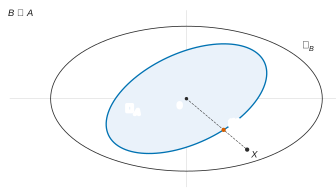
On prend $A,B\in\mathcal{S}_n^{++}(\mathbb{R})$ (pour que $\mathcal{B}_A,\mathcal{B}_B$ soient définies) ; $\mathcal{B}_A=\{X\,;\,(AX|X)\leqslant1\}$.
$(\Rightarrow)$ Si $X\in\mathcal{B}_A$, $(BX|X)\leqslant(AX|X)\leqslant1$, donc $X\in\mathcal{B}_B$.
$(\Leftarrow)$ Pour $X=0$ l'inégalité est claire. Pour $X\neq0$, posons $t=(AX|X)^{-1/2}$ ; alors $(A(tX)|tX)=1$, donc $tX\in\mathcal{B}_A\subset\mathcal{B}_B$ et $t^2(BX|X)\leqslant1$, soit $(BX|X)\leqslant(AX|X)$.
$$\boxed{B\preccurlyeq A\iff\mathcal{B}_A\subset\mathcal{B}_B.}$$
#### Q21
Pour $A\in\mathcal{S}_n^+(\mathbb{R})$ de valeurs propres $\mu_1,\dots,\mu_n\geqslant0$ (base orthonormée propre $(e_i)$), on a $\|A\|^2=\operatorname{tr}(A^2)=\sum\mu_i^2$.
$(\Leftarrow)$ Si $A\preccurlyeq\alpha I_n$ pour tout $A\in\mathcal{K}$, alors $\mu_i=(Ae_i|e_i)\leqslant\alpha$, donc $\mu_i\in[0,\alpha]$ et $\|A\|\leqslant\alpha\sqrt n$ : $\mathcal{K}$ est bornée.
$(\Rightarrow)$ Si $\|A\|\leqslant R$ ($R>0$) sur $\mathcal{K}$, l'inégalité de Cauchy-Schwarz appliquée à chaque ligne donne $\|AX\|\leqslant\|A\|\,\|X\|$, puis $(AX|X)\leqslant\|AX\|\,\|X\|\leqslant R\|X\|^2=(RI_nX|X)$ : $A\preccurlyeq RI_n$.
$$\boxed{\mathcal{K}\ \text{bornée}\iff\exists\alpha>0,\ \forall A\in\mathcal{K},\ A\preccurlyeq\alpha I_n.}$$
### II — Stricte log-concavité de l'application $\det$
#### Q22
Pour $A,B\in\mathcal{S}_n^{++}(\mathbb{R})$ et $t\in[0,1]$, $M=tA+(1-t)B$ est symétrique et, pour $X\neq0$, $(MX|X)=t(AX|X)+(1-t)(BX|X)>0$, car les deux termes $(AX|X),(BX|X)$ sont $>0$ et $t,1-t\geqslant0$ ne sont pas tous deux nuls. **$\mathcal{S}_n^{++}(\mathbb{R})$ est convexe.**
#### Q23
Soient $A,B\in\mathcal{S}_n^{++}(\mathbb{R})$. Pour $t\in\{0,1\}$ il y a égalité ; soit $t\in\,]0,1[$.
*Réduction simultanée.* Par Q16 et Q18, il existe une base $(\varepsilon_i)$, $\langle\cdot,\cdot\rangle_A$-orthonormée, avec $A^{-1}B\varepsilon_i=\lambda_i\varepsilon_i$, $\lambda_i>0$. Soit $P$ la matrice (inversible) de colonnes $\varepsilon_i$ : $(P^\top AP)_{ij}=\langle\varepsilon_i,\varepsilon_j\rangle_A=\delta_{ij}$ et $(P^\top BP)_{ij}=\langle\varepsilon_i,u(\varepsilon_j)\rangle_A=\lambda_j\delta_{ij}$. Donc $P^\top AP=I_n$, $P^\top BP=D=\mathrm{diag}(\lambda_i)$.
*Déterminants.* Avec $c=(\det P)^2>0$ : $c\det A=1$, $c\det B=\prod\lambda_i$, $c\det(tA+(1-t)B)=\prod(t+(1-t)\lambda_i)$. Donc
$$\varphi(tA+(1-t)B)-t\varphi(A)-(1-t)\varphi(B)=\sum_{i=1}^n\Bigl[\ln\bigl(t+(1-t)\lambda_i\bigr)-(1-t)\ln\lambda_i\Bigr].$$
*Inégalité scalaire.* Pour $\lambda>0$, soit $g(\lambda)=t+(1-t)\lambda-\lambda^{1-t}$. Alors $g'(\lambda)=(1-t)(1-\lambda^{-t})$ est $<0$ sur $]0,1[$ et $>0$ sur $]1,+\infty[$ ; donc $g\geqslant g(1)=0$, avec égalité si et seulement si $\lambda=1$. Ainsi $\ln(t+(1-t)\lambda)\geqslant(1-t)\ln\lambda$, avec égalité si et seulement si $\lambda=1$.
*Conclusion.* Chaque crochet est $\geqslant0$, donc $\varphi(tA+(1-t)B)\geqslant t\varphi(A)+(1-t)\varphi(B)$. Il y a égalité si et seulement si tous les $\lambda_i$ valent $1$, c'est-à-dire $D=I_n$, soit $P^\top BP=P^\top AP$, soit $B=A$.
$$\boxed{\varphi=\ln\circ\det\ \text{est strictement concave sur}\ \mathcal{S}_n^{++}(\mathbb{R}).}$$
### III — Groupe orthogonal associé à une matrice symétrique définie positive
#### Q24
*Existence de $B$.* Par le théorème spectral, $A=Q\Delta Q^\top$ avec $Q\in\mathrm{O}_n(\mathbb{R})$, $\Delta=\mathrm{diag}(\mu_i)$, $\mu_i>0$. Avec $B=\Delta^{1/2}Q^\top$ (inversible), $B^\top B=Q\Delta Q^\top=A$.
*Sous-groupe.* Si $M^\top AM=A$, alors $(\det M)^2\det A=\det A\neq0$, donc $\det M=\pm1$ : $\mathrm{O}(A)\subset\mathrm{GL}_n(\mathbb{R})$. $I_n\in\mathrm{O}(A)$ ; $(MN)^\top A(MN)=N^\top(M^\top AM)N=A$ ; et $A=(M^{-1})^\top(M^\top AM)M^{-1}=(M^{-1})^\top AM^{-1}$.
*Isomorphisme.* $\Psi:N\mapsto B^{-1}NB$ est un morphisme injectif de $\mathrm{GL}_n(\mathbb{R})$ dans lui-même. Avec $M=B^{-1}NB$ :
$$M^\top AM=B^\top N^\top(B^{-1})^\top B^\top BB^{-1}NB=B^\top N^\top NB,$$
donc $M^\top AM=A=B^\top B\iff N^\top N=I_n$ ($B$ inversible). Ainsi $\Psi(\mathrm{O}_n(\mathbb{R}))=\mathrm{O}(A)$ :
$$\boxed{\Psi:N\mapsto B^{-1}NB\ \text{est un isomorphisme de}\ \mathrm{O}_n(\mathbb{R})\ \text{sur}\ \mathrm{O}(A).}$$
#### Q25
$\mathrm{O}_n(\mathbb{R})=f^{-1}(\{I_n\})$ avec $f:M\mapsto M^\top M$ continue : il est fermé ; il est borné car $\|M\|^2=\operatorname{tr}(M^\top M)=n$. En dimension finie, il est compact. $\Psi$ est linéaire donc continue, et $\mathrm{O}(A)=\Psi(\mathrm{O}_n(\mathbb{R}))$ (Q24) : **$\mathrm{O}(A)$ est compact**, comme image continue d'un compact.
### IV — Sous-groupes compacts de $\mathrm{GL}_n(\mathbb{R})$
#### Q26
Soit $M\in G$ et $a=|\det M|>0$. Pour $k\in\mathbb{Z}$, $M^k\in G$ et $|\det M^k|=a^k$. L'application continue $M\mapsto|\det M|$ est bornée sur le compact $G$ : $(a^k)_{k\in\mathbb{Z}}$ est bornée. Si $a>1$, $a^k\to+\infty$ quand $k\to+\infty$ ; si $a<1$, $a^k\to+\infty$ quand $k\to-\infty$. Donc
$$\boxed{\forall M\in G,\ |\det M|=1.}$$
#### Q27
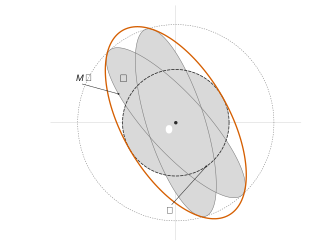
$\mathcal{B}$ est fermée bornée en dimension finie, donc compacte ; $G\times\mathcal{B}$ est compact (produit de compacts) ; $\Theta:(M,X)\mapsto MX$ est continue (coordonnées polynomiales). Donc $\mathcal{C}=\Theta(G\times\mathcal{B})$ **est compact.** Comme $I_n\in G$, $\mathcal{B}\subset\mathcal{C}$, donc $\mathcal{C}$ contient la boule ouverte de centre $0$ et de rayon $1$ : **$0$ est intérieur à $\mathcal{C}$.**
#### Q28
Pour $A\in\mathcal{S}_n^+(\mathbb{R})$, on pose $\mathcal{B}_A=\{X\,;\,(AX|X)\leqslant1\}$ (ce qui prolonge la définition de la partie I), et $\mathcal{E}=\{A\in\mathcal{S}_n^+(\mathbb{R})\,;\,\mathcal{C}\subset\mathcal{B}_A\}$.
*Non vide.* $\mathcal{C}$ est borné : $\mathcal{C}\subset\mathcal{B}(0,R)$ avec $R>0$. Par Q15, $\mathcal{B}(0,R)=\mathcal{B}_{A_0}$ avec $A_0=R^{-2}I_n$, donc $A_0\in\mathcal{E}$.
*Convexe.* Pour $A,A'\in\mathcal{E}$, $t\in[0,1]$ : $tA+(1-t)A'\in\mathcal{S}_n^+(\mathbb{R})$ (calcul de Q22 avec des inégalités larges) et, pour $X\in\mathcal{C}$, $((tA+(1-t)A')X|X)\leqslant t+(1-t)=1$.
*Fermé.* $\mathcal{S}_n(\mathbb{R})$ est un sous-espace, donc fermé, et pour $X$ fixé $A\mapsto(AX|X)$ est linéaire, donc continue. Ainsi
$$\mathcal{E}=\bigcap_{X\in\mathcal{M}_{n,1}(\mathbb{R})}\{A\in\mathcal{S}_n(\mathbb{R})\,;\,(AX|X)\geqslant0\}\ \cap\ \bigcap_{X\in\mathcal{C}}\{A\in\mathcal{S}_n(\mathbb{R})\,;\,(AX|X)\leqslant1\}$$
est une intersection de fermés.
*Borné.* $\mathcal{B}\subset\mathcal{C}$ (Q27). Pour $A\in\mathcal{E}$ et $Y\neq0$, $X=Y/\|Y\|\in\mathcal{C}$, donc $(AX|X)\leqslant1$, soit $(AY|Y)\leqslant\|Y\|^2$ : $A\preccurlyeq I_n$. Par Q21, $\mathcal{E}$ est bornée.
Fermé borné en dimension finie, **$\mathcal{E}$ est compact, non vide et convexe.**
*Existence.* $\det$ est continue ; elle atteint son maximum sur $\mathcal{E}$ en $A_1$. Comme $\det A_1\geqslant\det A_0=R^{-2n}>0$ et que les valeurs propres de $A_1\in\mathcal{S}_n^+(\mathbb{R})$ sont $\geqslant0$ de produit non nul, $A_1\in\mathcal{S}_n^{++}(\mathbb{R})$.
*Unicité.* Soient $A_1\neq A_2$ deux points de $\mathcal{E}$ où $\det$ vaut son maximum $m>0$ ; ils sont dans $\mathcal{S}_n^{++}(\mathbb{R})$. $A_3=\frac12(A_1+A_2)\in\mathcal{E}\cap\mathcal{S}_n^{++}(\mathbb{R})$ et, par Q23 avec $t=\frac12$ et $A_1\neq A_2$, $\ln\det A_3>\frac12\ln m+\frac12\ln m=\ln m$, ce qui contredit la maximalité. Donc $A_1=A_2$.
Toute $A\in\mathcal{S}_n^{++}(\mathbb{R})$ telle que $\mathcal{C}\subset\mathcal{B}_A$ est dans $\mathcal{E}$, donc
$$\boxed{\text{il existe une unique}\ A\in\mathcal{S}_n^{++}(\mathbb{R})\ \text{telle que}\ \mathcal{C}\subset\mathcal{B}_A\ \text{et}\ \det A\ \text{maximal.}}$$
#### Q29
Soit $A$ la matrice de Q28, $M\in G$ et $A'=M^\top AM$.
- $A'\in\mathcal{S}_n^{++}(\mathbb{R})$ : elle est symétrique et $(A'X|X)=(AMX|MX)>0$ pour $X\neq0$, car $M$ est inversible.
- $\det A'=(\det M)^2\det A=\det A$ (Q26).
- $\mathcal{C}\subset\mathcal{B}_{A'}$ : si $Y=NX\in\mathcal{C}$ ($N\in G$, $X\in\mathcal{B}$), alors $MY=(MN)X\in\mathcal{C}\subset\mathcal{B}_A$ car $MN\in G$, donc $(A'Y|Y)=(AMY|MY)\leqslant1$.
$A'$ est donc admissible et de déterminant maximal ; par unicité (Q28), $A'=A$, soit $M^\top AM=A$ et $M\in\mathrm{O}(A)$. Comme $G$ est un groupe pour la même loi,
$$\boxed{G\ \text{est un sous-groupe de}\ \mathrm{O}(A).}$$
Par Q24, $\Psi^{-1}(G)=BGB^{-1}$ est un sous-groupe de $\mathrm{O}_n(\mathbb{R})$ isomorphe à $G$ : tout sous-groupe compact de $\mathrm{GL}_n(\mathbb{R})$ est conjugué à un sous-groupe de $\mathrm{O}_n(\mathbb{R})$.
---
## Partie C — Croissance du groupe de Heisenberg discret
Dans la définition de $\ell_{\mathcal{S}}$, les $s_i$ parcourent $\mathcal{S}$ avec répétitions possibles et $k$ est quelconque : $\ell_{\mathcal{S}}(g)$ est la longueur minimale d'un mot en les $s^{\pm1}$, $s\in\mathcal{S}$, représentant $g$.
### I — Croissance d'un groupe
#### Q30
Comme $\mathcal{S}$ engendre $G$, tout $g$ admet une écriture $s_1^{a_1}\cdots s_k^{a_k}$, et l'ensemble des poids $\sum|a_i|$ est une partie non vide de $\mathbb{N}$ : $\ell_{\mathcal{S}}(g)$ est bien défini.
*Inverse.* Si $g=s_1^{a_1}\cdots s_k^{a_k}$ est une écriture de poids $\ell_{\mathcal{S}}(g)$, alors $g^{-1}=s_k^{-a_k}\cdots s_1^{-a_1}$ a le même poids, donc $\ell_{\mathcal{S}}(g^{-1})\leqslant\ell_{\mathcal{S}}(g)$ ; appliqué à $g^{-1}$, cela donne l'inégalité inverse. (Pour $g=e$ : $0=0$.)
*Produit.* En concaténant des écritures minimales de $g$ et $h$ (vides si $g=e$ ou $h=e$), on obtient une écriture de $gh$ de poids $\ell_{\mathcal{S}}(g)+\ell_{\mathcal{S}}(h)$. Donc
$$\boxed{\ell_{\mathcal{S}}(g^{-1})=\ell_{\mathcal{S}}(g),\qquad\ell_{\mathcal{S}}(gh)\leqslant\ell_{\mathcal{S}}(g)+\ell_{\mathcal{S}}(h).}$$
#### Q31
Posons $C'=\max(1,\max_{s\in\mathcal{S}}\ell_\Sigma(s))$ et $D=\max(1,\max_{\sigma\in\Sigma}\ell_{\mathcal{S}}(\sigma))$, entiers $\geqslant1$. Par Q30, $\ell_\Sigma(s^a)\leqslant|a|\,\ell_\Sigma(s)\leqslant|a|C'$. Pour une écriture minimale $g=s_1^{a_1}\cdots s_k^{a_k}$ :
$$\ell_\Sigma(g)\leqslant\sum_i\ell_\Sigma(s_i^{a_i})\leqslant C'\sum_i|a_i|=C'\ell_{\mathcal{S}}(g).$$
Symétriquement $\ell_{\mathcal{S}}(g)\leqslant D\,\ell_\Sigma(g)$. Avec $C=1/D$ :
$$\boxed{\forall g\in G,\quad C\,\ell_{\mathcal{S}}(g)\leqslant\ell_\Sigma(g)\leqslant C'\,\ell_{\mathcal{S}}(g).}$$
*Conséquence.* Supposons $\alpha p^d\leqslant|\mathcal{V}_{\mathcal{S}}(p)|\leqslant\beta p^d$ pour $p\geqslant1$.
- Si $\ell_\Sigma(g)\leqslant p$, alors $\ell_{\mathcal{S}}(g)\leqslant Dp$ : $\mathcal{V}_\Sigma(p)\subset\mathcal{V}_{\mathcal{S}}(Dp)$ et $|\mathcal{V}_\Sigma(p)|\leqslant\beta D^dp^d$.
- Si $\ell_{\mathcal{S}}(g)\leqslant q:=\lfloor p/C'\rfloor$, alors $\ell_\Sigma(g)\leqslant C'q\leqslant p$ : $\mathcal{V}_{\mathcal{S}}(q)\subset\mathcal{V}_\Sigma(p)$. Pour $p\geqslant C'$, $q\geqslant1$ et $q\geqslant\frac{p}{2C'}$ (car $\lfloor x\rfloor\geqslant x/2$ pour $x\geqslant1$), d'où $|\mathcal{V}_\Sigma(p)|\geqslant\alpha(2C')^{-d}p^d$. Pour $1\leqslant p<C'$, $|\mathcal{V}_\Sigma(p)|\geqslant1\geqslant(p/C')^d$.
Avec $\alpha'=\min(\alpha(2C')^{-d},C'^{-d})$ et $\beta'=\beta D^d$, on a $\alpha'p^d\leqslant|\mathcal{V}_\Sigma(p)|\leqslant\beta'p^d$ pour tout $p\geqslant1$ : **la croissance polynomiale de degré $d$ ne dépend pas de la partie génératrice finie.**
#### Q32
Le nombre de $(x,y,z)\in\mathbb{N}^3$ avec $x+y+z=s$ vaut $\sum_{x=0}^s(s-x+1)=\binom{s+2}{2}$. Par la formule de Pascal $\binom{s+2}{2}=\binom{s+3}{3}-\binom{s+2}{3}$, la somme télescope :
$$N(p)=\#\{(x,y,z)\in\mathbb{N}^3\,;\,x+y+z\leqslant p\}=\sum_{s=0}^p\binom{s+2}{2}=\boxed{\binom{p+3}{3}=\frac{(p+1)(p+2)(p+3)}{6}}.$$
Pour $\mathcal{S}=\{e_1,e_2,e_3\}$ dans $(\mathbb{Z}^3,+)$ : l'écriture $xe_1+ye_2+ze_3$ donne $\ell_{\mathcal{S}}(x,y,z)\leqslant|x|+|y|+|z|$ ; inversement, dans toute écriture $\sum a_ie_{j_i}$, $x$ est la somme des $a_i$ avec $j_i=1$ (de même pour $y,z$), donc $|x|+|y|+|z|\leqslant\sum|a_i|$. Ainsi $\ell_{\mathcal{S}}(x,y,z)=|x|+|y|+|z|$ et $\mathcal{V}_{\mathcal{S}}(p)=\{|x|+|y|+|z|\leqslant p\}$.
Cet ensemble contient les triplets de $\mathbb{N}^3$ de somme $\leqslant p$, et $(x,y,z)\mapsto(|x|,|y|,|z|)$ l'envoie sur ces triplets avec des fibres d'au plus $8$ éléments. Pour $p\geqslant1$ :
$$\frac{p^3}{6}\leqslant N(p)\leqslant|\mathcal{V}_{\mathcal{S}}(p)|\leqslant8N(p)\leqslant\frac{8\cdot2p\cdot3p\cdot4p}{6}=32p^3.$$
$$\boxed{(\mathbb{Z}^3,+)\ \text{est à croissance polynomiale de degré}\ 3.}$$
(Valeur exacte : $|\mathcal{V}_{\mathcal{S}}(p)|=\frac{(2p+1)(2p^2+2p+3)}{3}$, soit $7,25,63,\dots$)
### II — Le groupe de Heisenberg discret
On note $M(i,j,k)=\begin{pmatrix}1&j&k\\0&1&i\\0&0&1\end{pmatrix}$.
#### Q33
$S=I_3+E_{23}$, $T=I_3+E_{12}$, $U=I_3+E_{13}$, avec $E^2=0$ pour ces trois matrices, d'où $(I_3+E)^m=I_3+mE$ pour $m\in\mathbb{N}$, puis pour $m\in\mathbb{Z}$ car $(I_3+E)^{-1}=I_3-E$. Comme $E_{23}E_{12}=E_{12}E_{13}=E_{23}E_{13}=0$,
$$\boxed{S^iT^jU^k=I_3+iE_{23}+jE_{12}+kE_{13}=\begin{pmatrix}1&j&k\\0&1&i\\0&0&1\end{pmatrix}=M(i,j,k).}$$
#### Q34
Par produit matriciel,
$$M(i,j,k)M(i',j',k')=\begin{pmatrix}1&j+j'&k+k'+ji'\\0&1&i+i'\\0&0&1\end{pmatrix},$$
donc
$$\boxed{(i'',j'',k'')=(i+i',\ j+j',\ k+k'+ji').}$$
Conséquence : $K=\{M(i,j,k)\}$ est stable par produit, contient $I_3$ et $M(i,j,k)^{-1}=M(-i,-j,ij-k)$ ; c'est un sous-groupe contenant $S,T,U$, donc $\mathbb{H}\subset K$, et $K\subset\mathbb{H}$ par Q33 : $\mathbb{H}=\{M(i,j,k)\,;\,(i,j,k)\in\mathbb{Z}^3\}$.
#### Q35
Par Q34, $M(i,j,k)U=M(i,j,k+1)=UM(i,j,k)$ : **$U$ commute avec tout élément de $\mathbb{H}$.** Et
$$T^jS^i=M(0,j,0)M(i,0,0)=M(i,j,ij)=S^iT^jU^{ij}.\qquad\boxed{S^iT^jU^{ij}=T^jS^i.}$$
#### Q36
$ST=M(1,1,0)\neq M(1,1,1)=TS$ : **$\mathbb{H}$ n'est pas commutatif.** Avec $i=j=1$, Q35 donne $STU=TS$, donc $U=T^{-1}S^{-1}TS\in\langle S,T\rangle$ ; ainsi $\langle S,T\rangle$ contient $S,T,U$ :
$$\boxed{\langle S,T\rangle=\mathbb{H}.}$$
#### Q37
$f(i,j,k)=S^iT^jU^k\in\mathbb{H}$ : $f$ est bien définie. Par Q33 et Q34, $f(i,j,k)=M(i,j,k)$ et tout élément de $\mathbb{H}$ est de cette forme : $f$ est surjective. Elle est injective car $M(i,j,k)$ détermine $i$ (coefficient $(2,3)$), $j$ (coefficient $(1,2)$), $k$ (coefficient $(1,3)$).
$f$ **n'est pas un morphisme** pour $(\mathbb{Z}^3,+)$ : sinon $\mathbb{H}=f(\mathbb{Z}^3)$ serait commutatif ; concrètement $f((0,1,0)+(1,0,0))=ST\neq TS=f(0,1,0)f(1,0,0)$.
**Oui** : par transport de structure, la loi
$$(i,j,k)*(i',j',k')=f^{-1}\bigl(f(i,j,k)f(i',j',k')\bigr)=(i+i',\ j+j',\ k+k'+ji')$$
est une loi de groupe sur $\mathbb{Z}^3$ (associativité héritée de $\mathbb{H}$, neutre $(0,0,0)$, symétrique $(-i,-j,ij-k)$), et $f:(\mathbb{Z}^3,*)\to\mathbb{H}$ est un isomorphisme.
#### Q38
*Lemme.* Par récurrence à partir de Q34,
$$\prod_{\ell=1}^rM(i_\ell,j_\ell,k_\ell)=M\Bigl(\sum_\ell i_\ell,\ \sum_\ell j_\ell,\ \sum_\ell k_\ell+\sum_{\ell<\ell'}j_\ell i_{\ell'}\Bigr)$$
(au rang $r+1$, le nouveau terme croisé est $\bigl(\sum_{\ell\leqslant r}j_\ell\bigr)i_{r+1}$).
*Forme normale.* Soit $M\in\mathbb{H}$ avec $\ell_{\mathcal{A}}(M)\leqslant p$ et $M=X_1^{a_1}\cdots X_r^{a_r}$ une écriture minimale. Chaque facteur est $M(a_\ell,0,0)$, $M(0,a_\ell,0)$ ou $M(0,0,a_\ell)$ ; notons $i_\ell,j_\ell,k_\ell$ ses trois paramètres (deux sont nuls). Le lemme donne $M=S^iT^jU^{k+z}$ avec $i=\sum i_\ell$, $j=\sum j_\ell$, $k=\sum k_\ell$, $z=\sum_{\ell<\ell'}j_\ell i_{\ell'}$. Alors $|i|+|j|+|k|\leqslant\sum|a_\ell|\leqslant p$ et, avec $\hat\imath=\sum|i_\ell|$, $\hat\jmath=\sum|j_\ell|$ ($\hat\imath+\hat\jmath\leqslant p$),
$$|z|\leqslant\hat\imath\,\hat\jmath\leqslant\Bigl(\frac{\hat\imath+\hat\jmath}{2}\Bigr)^2\leqslant\frac{p^2}{4}.$$
$$\boxed{M=S^iT^jU^{k+z},\quad|i|+|j|+|k|\leqslant p,\quad|z|\leqslant\hat\imath\hat\jmath\leqslant p^2/4.}$$
*La borne $|z|\leqslant|ij|$ de l'énoncé est fausse en général.* On l'obtient quand les blocs $S$ ont tous des exposants de même signe, ainsi que les blocs $T$ ($\hat\imath=|i|$, $\hat\jmath=|j|$). Mais $ST^3S^{-1}=M(0,3,-3)$ (lemme) a une longueur $\leqslant5$ ; comme $f$ est bijective, toute écriture $M(0,3,-3)=S^iT^jU^{k+z}$ impose $i=0$, $j=3$, donc $|ij|=0$, $z=0$, $k=-3$, et $|i|+|j|+|k|=6>5$. De même $S^{10}T^{10}S^{-10}=M(0,10,-100)$ est de longueur $\leqslant30$. La majoration $|z|\leqslant p^2/4$ remplace celle de l'énoncé et suffit pour la suite.
*Dénombrement.* Pour $M\in\mathcal{V}_{\mathcal{A}}(p)$, $M=M(i,j,m)$ avec $|i|\leqslant p$, $|j|\leqslant p$, $|m|\leqslant|k|+|z|\leqslant p+p^2/4$. Comme $f$ est injective, pour $p\geqslant1$,
$$|\mathcal{V}_{\mathcal{A}}(p)|\leqslant(2p+1)^2\Bigl(2p+\frac{p^2}{2}+1\Bigr)\leqslant9p^2\cdot\frac72p^2\leqslant32p^4.$$
$$\boxed{|\mathcal{V}_{\mathcal{A}}(p)|=O(p^4),\ \text{et même}\ |\mathcal{V}_{\mathcal{A}}(p)|\leqslant32p^4\ \text{pour}\ p\geqslant1.}$$
#### Q39
*Cas $i,j,k\in\mathbb{N}$, $i+j\leqslant p$, $k\leqslant ij$.* Si $j=0$, alors $k=0$ et $S^i$ a un poids $i\leqslant p$. Si $j\geqslant1$, écrivons $k=jq+r$ avec $0\leqslant r<j$ ; $q\leqslant i$. Si $q<i$, on pose $(u,v)=(q+1,q)$ ; si $q=i$ (alors $r=0$ et $k=ij$), $(u,v)=(i,i)$. Avec $a=i-u$, $b=u-v$, $c=v$ (entiers naturels de somme $i$), le mot
$$W=S^aT^rS^bT^{j-r}S^c$$
a pour poids $i+j\leqslant p$, et le lemme de Q38 donne $W=M(i,j,z)$ avec $z=r(b+c)+(j-r)c=ru+(j-r)v$. Si $q<i$ : $z=r(q+1)+(j-r)q=k$. Si $q=i$ : $z=ji=k$. Donc $W=S^iT^jU^k$ et $\ell_{\mathcal{A}}(S^iT^jU^k)\leqslant i+j\leqslant p$.
*Cas $k$ du signe de $ij$.* Les applications $\psi_1:M(i,j,k)\mapsto M(-i,j,-k)$ et $\psi_2:M(i,j,k)\mapsto M(i,-j,-k)$ sont des morphismes involutifs de $\mathbb{H}$ (vérification directe sur la formule de Q34) qui envoient $\{S^{\pm1},T^{\pm1},U^{\pm1}\}$ dans lui-même, donc conservent $\ell_{\mathcal{A}}$. Si $|i|+|j|\leqslant p$, $|k|\leqslant|ij|$ et $k\,ij\geqslant0$, on se ramène par $\psi_1$, $\psi_2$ à $i,j\geqslant0$, donc $k\geqslant0$ (et $k=0$ si $ij=0$), et le premier cas s'applique :
$$\boxed{|i|+|j|\leqslant p,\ |k|\leqslant|ij|,\ k\,ij\geqslant0\ \Longrightarrow\ \ell_{\mathcal{A}}(S^iT^jU^k)\leqslant p.}$$
*Sans la condition de signe, l'énoncé est faux* : pour $(i,j,k)=(1,1,-1)$ et $p=2$, un mot de poids $\leqslant2$ représentant $M(1,1,-1)$ doit, par le lemme, avoir des exposants de $S$ de somme $1$ et de $T$ de somme $1$ ; il est donc formé d'un $S$ et d'un $T$ exactement, et vaut $ST=M(1,1,0)$ ou $TS=M(1,1,1)$. Donc $\ell_{\mathcal{A}}(STU^{-1})=3>2$. Ce point est sans effet sur la suite, qui n'utilise que des triplets de $\mathbb{N}^3$.
#### Q40
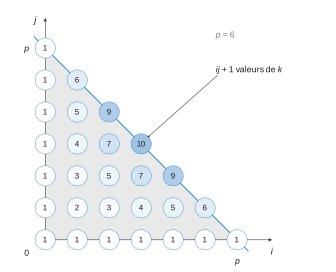
À $(i,j)$ fixé, il y a $ij+1$ valeurs de $k$. Donc, pour $p\geqslant1$,
$$\mathcal{N}_p=\sum_{i=0}^p\sum_{j=0}^{p-i}(ij+1)\geqslant\sum_{i=0}^p i\,\frac{(p-i)(p-i+1)}{2}\geqslant\frac12\sum_{i=0}^pi(p-i)^2=\boxed{\frac{p^3}{2}\sum_{i=0}^p\frac ip\Bigl(1-\frac ip\Bigr)^2},$$
en utilisant $p-i+1\geqslant p-i\geqslant0$.
Avec $h(t)=t(1-t)^2$, continue sur $[0,1]$ et nulle en $1$, $\frac1p\sum_{i=0}^ph(i/p)=\frac1p\sum_{i=0}^{p-1}h(i/p)$ est une somme de Riemann qui tend vers $\int_0^1t(1-t)^2\,\mathrm{d}t=\frac12-\frac23+\frac14=\frac1{12}\neq0$. Donc
$$\boxed{\frac{p^3}{2}\sum_{i=0}^p\frac ip\Bigl(1-\frac ip\Bigr)^2\underset{p\to+\infty}{\sim}\frac{p^4}{24}.}$$
(Valeur exacte : $\sum_{i=0}^pi(p-i)^2=\frac{p^2(p^2-1)}{12}$, donc la quantité vaut $\frac{p^2(p^2-1)}{24}$.)
#### Q41
*Majoration* : $|\mathcal{V}_{\mathcal{A}}(p)|\leqslant32p^4$ pour $p\geqslant1$ (Q38).
*Minoration* : pour $(i,j,k)\in\mathbb{N}^3$ avec $i+j\leqslant p$, $k\leqslant ij$, la condition de signe est satisfaite, donc $f(i,j,k)\in\mathcal{V}_{\mathcal{A}}(p)$ (Q39) ; ces éléments sont distincts ($f$ injective). Donc $|\mathcal{V}_{\mathcal{A}}(p)|\geqslant\mathcal{N}_p\geqslant\frac{p^2(p^2-1)}{24}$ (Q40). Pour $p\geqslant2$, $p^2-1\geqslant\frac34p^2$, donc $|\mathcal{V}_{\mathcal{A}}(p)|\geqslant\frac{p^4}{32}$ ; pour $p=1$, $|\mathcal{V}_{\mathcal{A}}(1)|=7\geqslant\frac1{32}$.
Ainsi $\frac1{32}p^4\leqslant|\mathcal{V}_{\mathcal{A}}(p)|\leqslant32p^4$ pour tout $p\geqslant1$, et par Q31 la propriété ne dépend pas de la partie génératrice :
$$\boxed{\mathbb{H}\ \text{est un groupe à croissance polynomiale de degré}\ 4.}$$
En particulier, bien qu'en bijection avec $\mathbb{Z}^3$, $\mathbb{H}$ n'est pas isomorphe à $(\mathbb{Z}^3,+)$ (degré $3$, Q32).
Aide sur le corrigé
Connectez-vous pour demander une explication.