Méthodes de calcul et raisonnement
Agro-VétoTB2026
# Agro-Véto TB — Méthodes de calcul et raisonnement 2026 · Corrigé brut
*Corrigé rédigé par IA (La Belle Copie), non officiel. Signalez toute erreur.*
Épreuve de 2 heures, sans calculatrice ni document. Trois exercices totalement indépendants.
## Exercice d'Algèbre
On note $A=\begin{pmatrix}-3&-4\\2&3\end{pmatrix}$.
### 1.
Pour $\lambda\in\mathbb R$,
$$\det(A-\lambda I_2)=\begin{vmatrix}-3-\lambda&-4\\2&3-\lambda\end{vmatrix}=(-3-\lambda)(3-\lambda)+8=\lambda^2-9+8=\lambda^2-1=(\lambda-1)(\lambda+1).$$
Un réel $\lambda$ est valeur propre de $A$ si et seulement si $A-\lambda I_2$ n'est pas inversible, c'est-à-dire, pour une matrice $2\times2$, si et seulement si $\det(A-\lambda I_2)=0$. Donc :
$$\boxed{\text{les valeurs propres de }A\text{ sont exactement }-1\text{ et }1.}$$
### 2.a.
Avec $U=\begin{pmatrix}-1\\1\end{pmatrix}$ :
$$AU=\begin{pmatrix}(-3)(-1)+(-4)(1)\\2(-1)+3(1)\end{pmatrix}=\begin{pmatrix}-1\\1\end{pmatrix}=U.$$
Comme $U\neq0$ et $AU=1\cdot U$, **$U$ est un vecteur propre de $A$ associé à la valeur propre $1$.**
### 2.b.
$$\boxed{m=-2}$$
(Vérification : $AV=\begin{pmatrix}-3m-4\\2m+3\end{pmatrix}=\begin{pmatrix}2\\-1\end{pmatrix}=-V$ pour $m=-2$.)
### 3.a.
Les colonnes de $P$ doivent être des vecteurs propres associés, dans l'ordre, aux coefficients diagonaux de $D$. L'ordre croissant impose $D=\mathrm{diag}(-1,1)$ ; on place donc $V$ (valeur propre $-1$) en première colonne et $U$ (valeur propre $1$) en seconde, ce qui donne bien une deuxième ligne formée de $1$ :
$$\boxed{D=\begin{pmatrix}-1&0\\0&1\end{pmatrix},\qquad P=\begin{pmatrix}-2&-1\\1&1\end{pmatrix}.}$$
$P$ est inversible car $\det P=(-2)(1)-(-1)(1)=-1\neq0$. Par construction, $AP=(AV\ \ AU)=(-V\ \ U)=PD$, d'où $A=PDP^{-1}$. Contrôle : $AP=PD=\begin{pmatrix}2&-1\\-1&1\end{pmatrix}$.
### 3.b.
Pour $M=\begin{pmatrix}a&b\\c&d\end{pmatrix}$ avec $ad-bc\neq0$, $M^{-1}=\dfrac1{ad-bc}\begin{pmatrix}d&-b\\-c&a\end{pmatrix}$. Ici $\det P=-1$ :
$$\boxed{P^{-1}=-\begin{pmatrix}1&1\\-1&-2\end{pmatrix}=\begin{pmatrix}-1&-1\\1&2\end{pmatrix}.}$$
Vérification : $PP^{-1}=\begin{pmatrix}2-1&2-2\\-1+1&-1+2\end{pmatrix}=I_2$.
### 4.
Comme $A=PDP^{-1}$, on a $D=P^{-1}AP$. Posons $Y=P^{-1}XP$ et $C=P^{-1}BP$ ; comme $P$ est inversible, cela équivaut à $X=PYP^{-1}$ et $B=PCP^{-1}$.
*Sens direct.* Si $AX+XA=B$, on multiplie à gauche par $P^{-1}$ et à droite par $P$, en insérant $PP^{-1}=I_2$ :
$$P^{-1}AXP+P^{-1}XAP=(P^{-1}AP)(P^{-1}XP)+(P^{-1}XP)(P^{-1}AP)=DY+YD,$$
donc $DY+YD=P^{-1}BP=C$.
*Réciproque.* Si $DY+YD=C$, on multiplie à gauche par $P$ et à droite par $P^{-1}$ :
$$PDYP^{-1}+PYDP^{-1}=(PDP^{-1})(PYP^{-1})+(PYP^{-1})(PDP^{-1})=AX+XA,$$
et $PCP^{-1}=B$, donc $AX+XA=B$.
$$\boxed{AX+XA=B\iff DY+YD=C.}$$
### 5.a.
$$P^{-1}B=\begin{pmatrix}-1&-1\\1&2\end{pmatrix}\begin{pmatrix}4&4\\-2&-2\end{pmatrix}=\begin{pmatrix}-2&-2\\0&0\end{pmatrix},$$
$$C=(P^{-1}B)P=\begin{pmatrix}-2&-2\\0&0\end{pmatrix}\begin{pmatrix}-2&-1\\1&1\end{pmatrix}=\begin{pmatrix}4-2&2-2\\0&0\end{pmatrix}=\boxed{\begin{pmatrix}2&0\\0&0\end{pmatrix}}.$$
### 5.b.
Avec $Y=\begin{pmatrix}a&b\\c&d\end{pmatrix}$ :
$$DY=\begin{pmatrix}-a&-b\\c&d\end{pmatrix},\qquad YD=\begin{pmatrix}-a&b\\-c&d\end{pmatrix},\qquad DY+YD=\begin{pmatrix}-2a&0\\0&2d\end{pmatrix}.$$
Par identification des coefficients, $DY+YD=C$ équivaut à $-2a=2$, $0=0$, $0=0$, $2d=0$, soit $a=-1$, $d=0$, $b$ et $c$ quelconques :
$$\boxed{\{Y\in\mathcal M_2(\mathbb R)\ :\ DY+YD=C\}=\left\{\begin{pmatrix}-1&b\\c&0\end{pmatrix}\ ;\ (b,c)\in\mathbb R^2\right\}.}$$
### 5.c.
D'après la question 4, $X$ est solution de $(E)$ si et seulement si $Y=P^{-1}XP$ est l'une des matrices de 5.b, c'est-à-dire si et seulement si $X=PYP^{-1}$ avec $Y=\begin{pmatrix}-1&b\\c&0\end{pmatrix}$, $(b,c)\in\mathbb R^2$. On calcule
$$PY=\begin{pmatrix}-2&-1\\1&1\end{pmatrix}\begin{pmatrix}-1&b\\c&0\end{pmatrix}=\begin{pmatrix}2-c&-2b\\c-1&b\end{pmatrix},$$
$$PYP^{-1}=\begin{pmatrix}2-c&-2b\\c-1&b\end{pmatrix}\begin{pmatrix}-1&-1\\1&2\end{pmatrix}=\begin{pmatrix}c-2b-2&c-4b-2\\-c+b+1&-c+2b+1\end{pmatrix}.$$
$$\boxed{\mathcal S_E=\left\{\begin{pmatrix}c-2b-2&c-4b-2\\b-c+1&2b-c+1\end{pmatrix}\ ;\ (b,c)\in\mathbb R^2\right\}.}$$
Autrement dit, $X=X_0+bM+cM'$ avec $X_0=\begin{pmatrix}-2&-2\\1&1\end{pmatrix}$, $M=\begin{pmatrix}-2&-4\\1&2\end{pmatrix}$, $M'=\begin{pmatrix}1&1\\-1&-1\end{pmatrix}$. Vérification pour $b=c=0$ : $AX_0=X_0A=\begin{pmatrix}2&2\\-1&-1\end{pmatrix}$, donc $AX_0+X_0A=B$.
### 6.
On calcule $C=P^{-1}BP$ pour $B=\begin{pmatrix}1&1\\-1&-1\end{pmatrix}$ :
$$P^{-1}B=\begin{pmatrix}-1&-1\\1&2\end{pmatrix}\begin{pmatrix}1&1\\-1&-1\end{pmatrix}=\begin{pmatrix}0&0\\-1&-1\end{pmatrix},\qquad C=\begin{pmatrix}0&0\\-1&-1\end{pmatrix}\begin{pmatrix}-2&-1\\1&1\end{pmatrix}=\begin{pmatrix}0&0\\1&0\end{pmatrix}.$$
D'après la question 4, $(E)$ a une solution si et seulement s'il existe $Y=\begin{pmatrix}a&b\\c&d\end{pmatrix}$ telle que $DY+YD=C$. Or d'après 5.b, $DY+YD=\begin{pmatrix}-2a&0\\0&2d\end{pmatrix}$ a toujours un coefficient $(2,1)$ nul, alors que celui de $C$ vaut $1$ : l'égalité imposerait $0=1$. Aucune matrice $Y$ ne convient, donc :
$$\boxed{\text{pour }B=\begin{pmatrix}1&1\\-1&-1\end{pmatrix},\ \text{l'équation }(E)\text{ n'a aucune solution.}}$$
## Exercice d'Analyse
Pour $n\in\mathbb N$, $x\mapsto x^ne^x$ est continue sur $[0,1]$, donc $I_n=\int_0^1x^ne^x\,\mathrm dx$ est bien définie.
### 1.
$$I_0=\int_0^1e^x\,\mathrm dx=\big[e^x\big]_0^1=\boxed{e-1}.$$
### 2.a.
$g$ est dérivable sur $\mathbb R$ et, par dérivation d'un produit, pour tout $x\in\mathbb R$ :
$$g'(x)=\big(e^x+xe^x\big)-e^x=\boxed{xe^x}.$$
### 2.b.
D'après 2.a, $g$ est une primitive de $x\mapsto xe^x$ sur $[0,1]$, donc
$$I_1=\big[g(x)\big]_0^1=g(1)-g(0)=(e-e)-(0-1)=\boxed{1}.$$
### 3.
Soit $n\in\mathbb N$. Pour tout $x\in[0,1]$, $x^n\ge0$ et $e^x>0$, donc $x^ne^x\ge0$. La fonction $x\mapsto x^ne^x$ est continue et positive sur $[0,1]$, et $0\le1$ : par positivité de l'intégrale,
$$\boxed{\forall n\in\mathbb N,\quad I_n\ge0.}$$
### 4.a.
Soit $x\in[0,1]$ et $n\in\mathbb N$. En multipliant l'inégalité $x\le1$ par $x^n\ge0$, on obtient $x^{n+1}\le x^n$. En multipliant par $e^x>0$ :
$$\boxed{x^{n+1}\le x^n\qquad\text{et}\qquad x^{n+1}e^x\le x^ne^x.}$$
### 4.b.
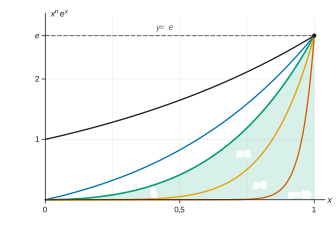
Pour $n\in\mathbb N$, les fonctions $x\mapsto x^{n+1}e^x$ et $x\mapsto x^ne^x$ sont continues sur $[0,1]$ et vérifient l'inégalité de 4.a sur $[0,1]$. Par croissance de l'intégrale ($0\le1$), $I_{n+1}\le I_n$. Ceci pour tout $n$ :
$$\boxed{(I_n)_{n\in\mathbb N}\text{ est décroissante.}}$$
### 5.a.
Soit $x\in[0,1]$, $n\in\mathbb N$. L'exponentielle est croissante et $x\le1$, donc $e^x\le e$. En multipliant par $x^n\ge0$ :
$$\boxed{x^ne^x\le e\,x^n.}$$
### 5.b.
Par croissance de l'intégrale (fonctions continues sur $[0,1]$, $0\le1$) et linéarité :
$$I_n\le\int_0^1e\,x^n\,\mathrm dx=e\left[\frac{x^{n+1}}{n+1}\right]_0^1=\boxed{\frac{e}{n+1}}.$$
### 5.c.
D'après 3 et 5.b, pour tout $n\in\mathbb N$, $0\le I_n\le\dfrac e{n+1}$. Comme $\dfrac e{n+1}\xrightarrow[n\to+\infty]{}0$, le théorème d'encadrement donne :
$$\boxed{(I_n)\text{ converge et }\lim_{n\to+\infty}I_n=0.}$$
### 6.a.
Soit $n\in\mathbb N$. On pose $u(x)=x^{n+1}$ et $v(x)=e^x$, de classe $\mathcal C^1$ sur $[0,1]$, avec $u'(x)=(n+1)x^n$ et $v'(x)=e^x$. Par intégration par parties :
$$I_{n+1}=\big[x^{n+1}e^x\big]_0^1-\int_0^1(n+1)x^ne^x\,\mathrm dx=e-0-(n+1)I_n,$$
car $0^{n+1}=0$ puisque $n+1\ge1$. Donc
$$\boxed{\forall n\in\mathbb N,\quad I_{n+1}=e-(n+1)I_n.}$$
(Pour $n=0$ : $I_1=e-(e-1)=1$, en accord avec 2.b.)
### 6.b.
De 6.a, $(n+1)I_n=e-I_{n+1}$ et $n+1\neq0$, donc
$$\boxed{\forall n\in\mathbb N,\quad I_n=\frac{e-I_{n+1}}{n+1}.}$$
### 6.c.
Pour $n\in\mathbb N$, d'après 6.b,
$$nI_n=\frac{n}{n+1}\,\big(e-I_{n+1}\big).$$
Or $\dfrac n{n+1}=\dfrac1{1+1/n}\to1$ et, d'après 5.c, $I_{n+1}\to0$, donc $e-I_{n+1}\to e$. Par produit :
$$\boxed{\lim_{n\to+\infty}nI_n=e.}$$
Comme $e\neq0$, on a $\dfrac{I_n}{e/n}=\dfrac{nI_n}{e}\to1$, c'est-à-dire
$$\boxed{I_n\underset{n\to+\infty}{\sim}\frac en.}$$
## Exercice de Probabilités
Pour tout $i\ge1$, l'urne ne contenant que des boules vertes et une rouge, $V_i=\overline{R_i}$.
### Partie 1
$N=3$ : 2 boules vertes, 1 rouge, tirages sans remise jusqu'à obtenir la rouge.
#### 1.
$$\boxed{P(R_1)=\frac13}$$
(tirage équiprobable d'une boule parmi 3, une seule rouge).
#### 2.a.
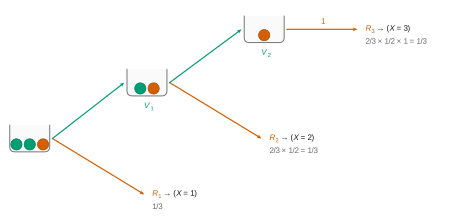
$$\boxed{P(V_1)=\frac23,\qquad P_{V_1}(R_2)=\frac12}$$
(sachant $V_1$, l'urne contient 1 verte et 1 rouge).
#### 2.b.
Comme $P(V_1)\neq0$, par la formule des probabilités composées :
$$P(V_1\cap R_2)=P(V_1)\,P_{V_1}(R_2)=\frac23\times\frac12=\boxed{\frac13}.$$
#### 3.
On a $P(V_1)=\frac23\neq0$ ; sachant $V_1$, l'urne contient 1 verte et 1 rouge, donc $P_{V_1}(V_2)=\frac12$ et $P(V_1\cap V_2)=\frac13\neq0$. Sachant $V_1\cap V_2$, les deux vertes ont été retirées et seule la rouge reste, donc $P_{V_1\cap V_2}(R_3)=1$. Par la formule des probabilités composées :
$$P(V_1\cap V_2\cap R_3)=P(V_1)\,P_{V_1}(V_2)\,P_{V_1\cap V_2}(R_3)=\frac23\times\frac12\times1=\boxed{\frac13}.$$
#### 4.a.
Il faut au moins un tirage, et comme les tirages se font sans remise, après deux vertes il ne reste que la rouge, tirée au troisième tirage. Les trois valeurs sont atteintes (probabilités non nulles en 4.b) :
$$\boxed{X(\Omega)=\{1,2,3\}.}$$
#### 4.b.
On traduit chaque événement :
- $(X=1)=R_1$, donc $P(X=1)=P(R_1)=\frac13$ (question 1) ;
- $(X=2)=V_1\cap R_2$, donc $P(X=2)=\frac13$ (question 2.b) ;
- $(X=3)=V_1\cap V_2\cap R_3$, donc $P(X=3)=\frac13$ (question 3).
$$\boxed{P(X=1)=P(X=2)=P(X=3)=\frac13}$$
(contrôle : la somme vaut $1$).
#### 4.c.
$X$ prend les valeurs $1,2,3$, chacune avec probabilité $\frac13$ :
$$\boxed{X\text{ suit la loi uniforme sur }\{1,2,3\}.}$$
#### 4.d.
$X$ est finie, donc admet une espérance :
$$E(X)=1\times\frac13+2\times\frac13+3\times\frac13=\boxed{2}.$$
**Il faut en moyenne 2 tirages pour obtenir la boule rouge.**
### Partie 2
$N\ge3$, tirages avec remise : la composition de l'urne est la même à chaque tirage, et les tirages sont mutuellement indépendants.
#### 1.
$$\boxed{\forall i\ge1,\quad P(R_i)=\frac1N,\qquad P(V_i)=\frac{N-1}N.}$$
#### 2.a.
Les événements $R_1\cap R_2\cap V_3$ et $V_1\cap V_2\cap R_3$ sont incompatibles, le premier étant inclus dans $R_1$ et le second dans $V_1=\overline{R_1}$. Donc
$$P(Y=3)=P(R_1\cap R_2\cap V_3)+P(V_1\cap V_2\cap R_3).$$
Par indépendance mutuelle des tirages (avec remise) :
$$P(R_1\cap R_2\cap V_3)=\frac1{N^2}\cdot\frac{N-1}N=\frac{N-1}{N^3},\qquad P(V_1\cap V_2\cap R_3)=\frac{(N-1)^2}{N^2}\cdot\frac1N=\frac{(N-1)^2}{N^3}.$$
$$P(Y=3)=\frac{(N-1)\big(1+(N-1)\big)}{N^3}=\frac{(N-1)N}{N^3}=\boxed{\frac{N-1}{N^2}}.$$
#### 2.b.
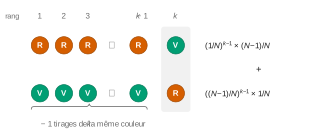
Soit $k\ge2$. L'événement $(Y=k)$ signifie qu'après $k-1$ tirages on n'a pas encore vu les deux couleurs, donc que les $k-1$ premiers tirages sont tous de la même couleur, et que le $k$-ième tirage donne l'autre couleur. Ainsi
$$(Y=k)=\big(R_1\cap\cdots\cap R_{k-1}\cap V_k\big)\cup\big(V_1\cap\cdots\cap V_{k-1}\cap R_k\big),$$
réunion de deux événements incompatibles (inclus respectivement dans $R_1$ et dans $V_1$). Par indépendance mutuelle des tirages :
$$P(Y=k)=\left(\frac1N\right)^{k-1}\frac{N-1}N+\left(\frac{N-1}N\right)^{k-1}\frac1N.$$
$$\boxed{\forall k\ge2,\quad P(Y=k)=\frac{(N-1)+(N-1)^{k-1}}{N^k}.}$$
Contrôles : pour $k=3$ on retrouve $\frac{(N-1)N}{N^3}=\frac{N-1}{N^2}$ (question 2.a) ; pour $k=2$, $P(Y=2)=\frac{2(N-1)}{N^2}$. Par ailleurs $Y\ge2$ (un seul tirage ne donne qu'une couleur), et la somme des deux séries géométriques vaut $\frac1N+\frac{N-1}N=1$, de sorte que $Y$ est finie presque sûrement.
Aide sur le corrigé
Connectez-vous pour demander une explication.